
In 1915, Albert Einstein unveiled his general theory of relativity and transformed our view of the fabric of the physical world. The theory, which explains gravitation as a deformation of space-time by mass, is a pinnacle of modern physics that underpins cosmology, from work on black holes to measurements of gravitational waves, and is used routinely to guide space missions and GPS satellites. It has also become a yardstick for leaders in the field of artificial-intelligence technology, who are asking whether their creations could ever make a breakthrough on that level. At the India AI Summit in New Delhi this February, Demis Hassabis, the co-founder of Google DeepMind in London, proposed training a large language model (LLM) on all that was known before a particular cut-off date ' he suggested the year 1911 ' to see whether it could reproduce general relativity. 'That would be a good test for AGI,' Hassabis said, referring to the nebulous concept of artificial general intelligence that is a goal for many in the AI industry....

In Professor Anna-Christina Eilers' research group, mentorship happens through small, meaningful gestures: thoughtful feedback on a draft, a check-in after a rough week, and a readiness to help when things get tough. For her students, these everyday moments have become a defining feature of her approach.An observational astrophysicist, Eilers studies how the universe evolved from its earliest beginnings. Her research investigates the formation and growth of black holes across cosmic time, particularly during the 'cosmic dawn,' when the first stars, galaxies, and quasars illuminated the young universe.Working alongside her in this field, graduate students describe a mentor who pairs high expectations with genuine attentiveness, encouraging both scientific independence and a strong sense of community. This approach has earned Eilers recognition through MITs Committed to Caring initiative ' a student-driven program honoring exemplary mentorship within the graduate community. Students say one of Eilers' defining qualities is her consistency. No matter how busy her schedule, they know they can count on thoughtful feedback, productive meetings, and regular conversations about both research and broader career development. While those practices may sound routine, her mentees emphasize that they are anything but guaranteed within many academic spaces....
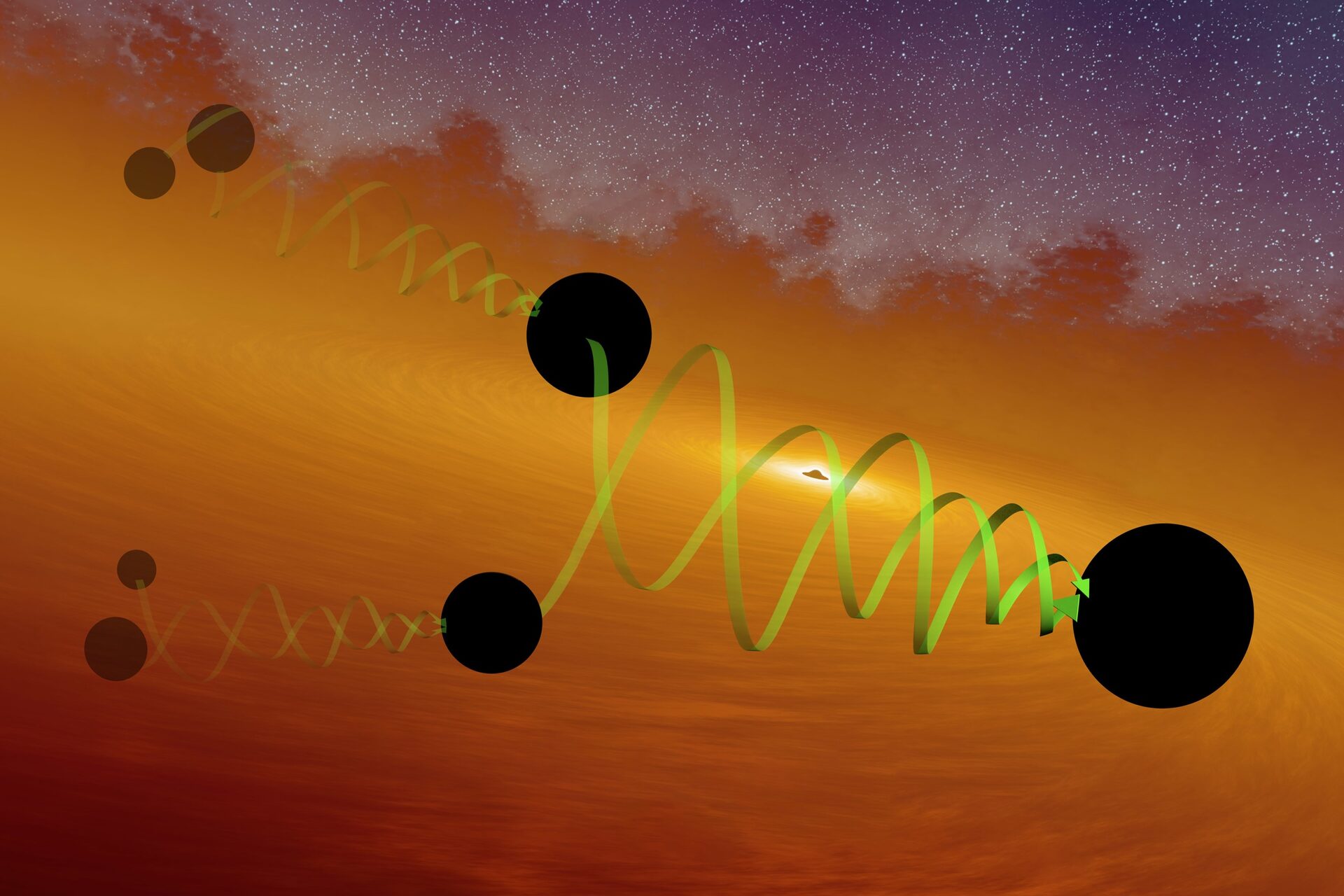
When a star dies, a black hole is born. This has been the textbook origin story for most black holes. At the end of a massive star's life, its outer layers blast away in a brilliant supernova, and its core collapses into a gravitationally tight and dense region, forming a black hole. Recent discoveries from gravitational-wave detectors have revealed hundreds of merging black holes across the universe. Many of them have been thought to come directly from exploding stars. But black holes can also come from other, smaller black holes. The products of previous black hole mergers can, in principle, merge again, creating a more massive black hole. This alternative, black-holes-birthing-black-holes pathway is known as 'hierarchical merging.' Now MIT scientists are finding that a good number of merging black holes may have indeed merged before. They carried out a new analysis of recent data from the LIGO, Virgo, and KAGRA observatories, containing 155 pairs of binary black holes, and found about 14 percent of merging black holes in the universe may in fact be second-generation black holes that formed from the previous merging of two smaller black holes....
But rather than a tunnel of nothing, a black hole is actually something ' and a lot of it. The densest objects in the universe, black holes exert tremendous gravitational pull, gathering in the surrounding fabric of space and time, and generating huge disks of matter that whirl toward a black hole before falling in, past the point of no return. 'It used to be that we didn't have eyes on systems all the time,' says Erin Kara, an associate professor of physics at MIT. 'Now we're seeing that they can turn on and off at rates that are much faster than we ever thought possible. We see things are getting sucked in toward black holes faster than we thought, perhaps due to stars whipping around and getting trapped in a black hole's accretion disk.' Kara and her group in MIT's Kavli Institute for Astrophysics and Space Research are at the forefront of black hole physics. She is using data from telescopes in space and on the ground to study the properties of black holes, especially supermassive black holes ' the ultradense giants at the centers of galaxies. Supermassive black holes are the engines of galaxy formation. Kara, who recently earned tenure at MIT, seeks to connect the extreme physics of black holes with how galaxies such as our own Milky Way come to be....


