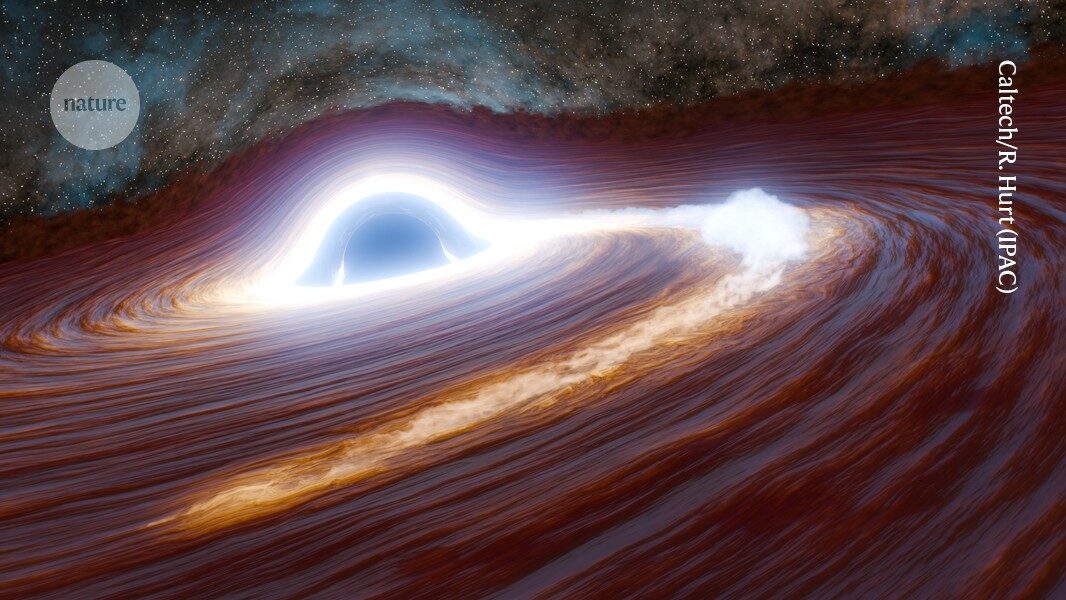
Black holes can get energy boosts by 'snacking', although their dish of choice is rather different from our own. Analysis suggests that the most luminous burst of light ever detected from a black hole ' a fireworks show that was, at its peak, more than 10 trillion times brighter than the Sun ' flared up as the black hole gobbled up a star that was at least 30 times as massive as the Sun. When astronomers first laid eyes on the object in 2018, they didn't realize it was a superflare. After noticing the object brighten, researchers zeroed in on it with the Palomar Observatory's 200-inch Hale Telescope. But a graph of the light emitted by the object proved disappointing. 'It didn't seem nearly as interesting as we thought it was,' says Matthew Graham, an astronomer at the California Institute of Technology in Pasadena and a co-author of the paper. However, in 2023, the team noticed that, even after five years, the black hole remained peculiarly bright. So they took a closer look using...
learn more