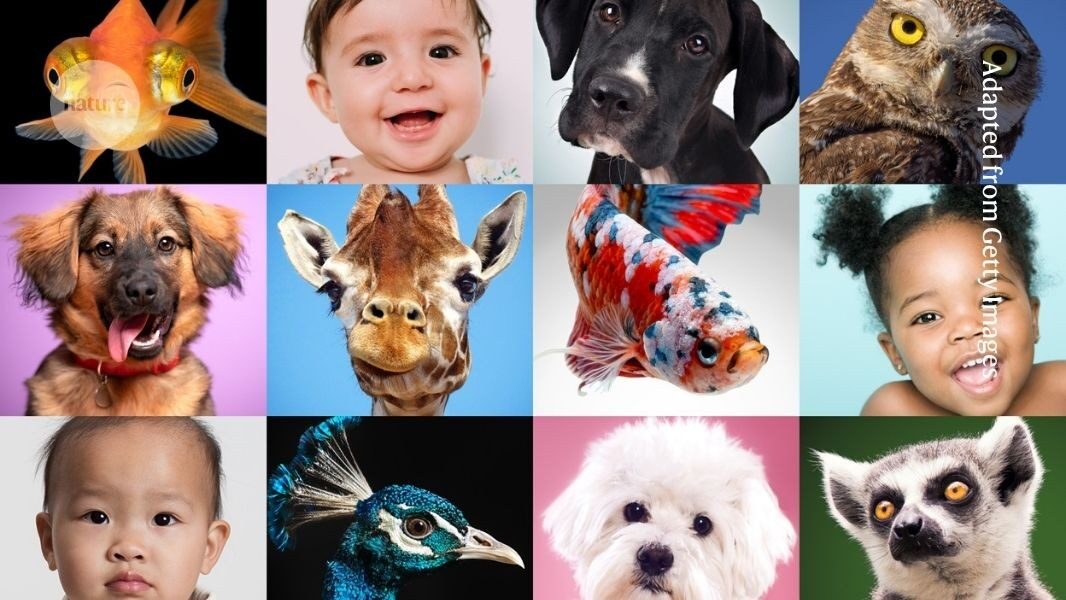
Thousands of human and animal subjects are being assessed in large replication studies. Getty/From L'R: top: Alastair Pollock; Volanthevist; Retales Botijero; Beata Whitehead. Middle: Anita Kot; Laura Mckenzie Waters; Sritanan; Jamie Grill. Bottom: Allen Chen; Henrik Sorensen; Emilija Manevska; StockImages_AT. Baby Zoe sits on her mother's lap and watches a puppet show featuring three shapes with googly eyes. A red circle struggles to climb a steep hill until a blue square helps it with a push. A yellow triangle blocks the way and shoves the red circle down the hill. When the show is over, Zoe is offered a choice of puppets. She doesn't hesitate: she ignores the unkind yellow triangle and makes a grab for the helpful blue square. The scene, from a Netflix documentary series released in 2020, recreates a highly cited 2007 study1, which found that babies as young as six months old overwhelmingly prefer characters who help, rather than hinder, others. On the basis of these findings, developmental psychologist Kiley Hamlin, now at the University of British Columbia in Vancouver, Canada, concluded that the ability to evaluate others' behaviour develops before speech, and could be a biological adaptation....

Despite how natural friendship can feel, people rarely stop to analyze it. How do you know when someone will make a good friend' When is it time to move on from a friendship' Oftentimes, people rely on gut intuitions to answer these kinds of questions. In psychology research, there's no universally accepted definition of a friend. Traditionally, when psychologists have analyzed friendship, it's often been through the lens of exchange. How much did that friend do for me' How much did I do for them' The idea is that friendships are transactional, where friends stick around only as long as they are getting at least as much as they are giving in the friendship. But this focus doesn't capture what feels like the essence of friendship for many people. We and our colleagues think another model for relationships ' what we call risk-pooling ' better matches what many people experience. In this kind of friendship, no one is keeping track of who did what for whom. Our research over the past decade suggests that this kind of friendship was essential for our ancient ancestors to survive the challenges they encountered. And we feel it's essential for surviving the challenges of life today, whether navigating personal struggles or dealing with natural disasters....

You're in a meeting when your boss suggests changing a number to make the quarterly report look stronger. Heads nod. The slides move on. You feel a knot in your stomach: Do you speak up and risk being branded difficult, or stay silent and become complicit' I first saw the power of defiance not in the workplace, but closer to home. My mother was the ultimate people-pleaser: timid, polite, eager to accommodate. Barely 4 feet, 10 inches tall, she put everyone else's needs above her own. But one day, when I was 7, I saw a different side to her. My reaction was instantaneous: Stay quiet, avoid conflict and get past them as quickly as possible. I grabbed my mother's arm, urging her to move with me. But she didn't. My quiet, deferential, never-confrontational mother did something completely different. She stopped, turned and looked the boys directly in the eyes. Then she asked, calmly but firmly, 'What do you mean'' I've carried these lessons into my work as a physician-turned-organizational psychologist. For decades, I've studied why people comply, staying silent when they don't want to, and how they can resist wisely. In my book 'Defy: The Power of No in a World that Demands Yes,' I offer a framework based on behavioral science research that can help you defy in ways that are intentional, effective and true to your values....
An innovative artificial intelligence (AI) system can predict the decisions people will make in a wide variety of situations ' often outperforming classical theories used in psychology to describe human choices. The researchers who developed the system, called Centaur, fine-tuned a large language model (LLM) using a massive set of data from 160 psychology experiments, in which 60,000 people made more than 10 million choices across many tasks. Most computer models and cognitive theories stick to a single task. For instance, Google Deepmind's AlphaGo can only play the strategy game Go, and prospect theory can only predict how a person will choose between potential losses and gains. Centaur, by contrast, can simulate human behaviour across a spectrum of tasks ' including gambling, memory games and problem-solving. During testing, it was even able to predict people's choices in tasks it had not been trained on. The development of Centaur is described in a paper published today in Nature1. The team that created the system thinks that it could one day become a valuable tool in cognitive science. 'You can basically run experimental sessions in silico instead of running them on actual human participants,' says study co-author Marcel Binz, a cognitive scientist at the Helmholtz Institute for Human-Centered AI in Munich, Germany. That could be useful when conventional studies would be too slow, he says, or when it's difficult to recruit children or people with psychiatric conditions....