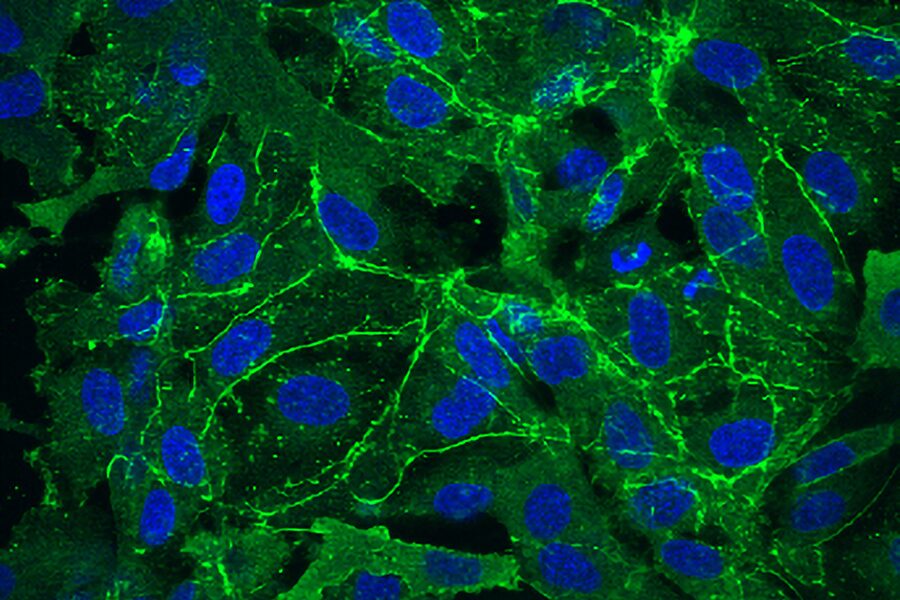
MIT researchers have discovered that two common genetic mutations that cause Rett syndrome each set off a molecular chain of events that compromises the structural integrity of developing brain blood vessels, making them leaky. The study traces the problem to overexpression of a particular microRNA (miRNA-126-3p), and shows that tamping down the miRNA's levels helps to rescue the vascular defect. Rett syndrome is a severe developmental disorder affecting both the brain and body. It is caused by various mutations in the widely expressed MECP2 gene, but the first symptoms don't become apparent until affected children (mostly girls) reach 2-3 years of age. Because that's a critical time in development for the brain's blood vessels, neuroscientists in The Picower Institute for Learning and Memory at MIT embarked on a study to model how two common but distinct MeCP2 mutations may affect vascular development and contribute to the disease's profound neurological pathology. To conduct the research published recently in Molecular Psychiatry, lead author Tatsuya Osaki and senior author Mriganka Sur developed advanced human tissue cultures to model vessel development, with and without the MeCP2 mutations. The cultures not only enabled them to model and closely observe how the mutations affected the vessels, but also allowed them to molecularly dissect the problems they observed and then to test an intervention that helped....
Hear the biggest stories from the world of science | 11 March 2026...

These three are some of the oldest members of a group of centenarians in Brazil who are providing scientific clues about the limits of human longevity. Participants in the DNA Longevo (Portuguese for Long-lived DNA) study are still being recruited, but scientists have already sequenced the genomes of more than 160 centenarians. Twenty participants are 'supercentenarians' ' those who reached the age of 110. Early data show that the supercentenarians did not have especially healthy diets or exercise routines or access to high-end medicine for most of their lives. The secret to their long lives might instead lie in their genomes. In a preliminary report1 published this month, researchers hypothesize that the participants' genetic diversity could have a role in their resilience. 'We know that Brazil has a highly mixed population, and that may contribute to their longevity,' says geneticist Mayana Zatz, who leads the project at the Human Genome and Stem Cell Research Center at the University of Sao Paulo....

A gene that is important for human hearing could determine whether a dog's ears are pendulous like a basset hound's or stubby like a rottweiler's, according to a genetic analysis of more than 3,000 dogs, wolves and coyotes. The study, presented on 11 January at the Plant and Animal Genome Conference in San Diego, California, found that DNA variants near a gene called MSRB3 are linked to ear length in dogs. The results were also published in December in Scientific Reports1. The project was inspired by Cobain, a gregarious, nine-year-old American cocker spaniel whose hobbies include morning swims in a local creek and following people from room to room. One day, Anna Ramey, an undergraduate working in a canine genetics laboratory at the University of Georgia in Athens, gazed at her dog Cobain's long, floppy ears and wondered: why' She took the question to her colleagues, and the project was born. 'We realized that people had studied ear carriage before ' like pointy, erect ears versus floppy, dropped ears,' says Tori Rudolph, a geneticist at the lab. 'But no one had looked at ear length in dogs.'...