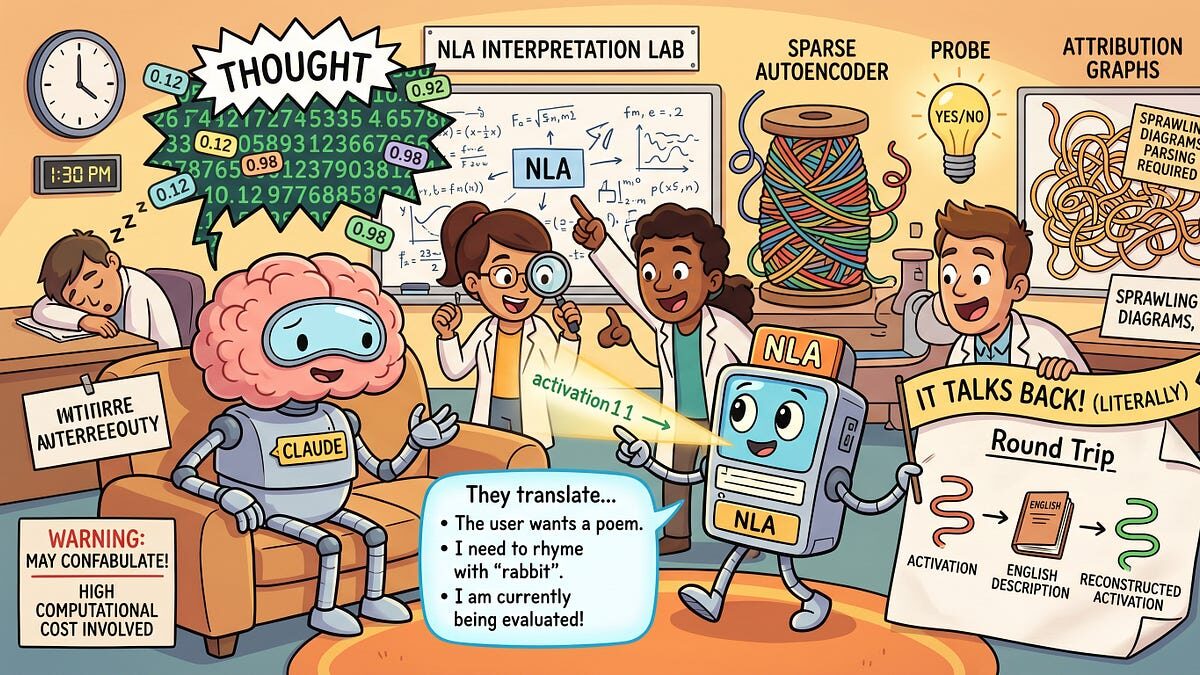
There is a recurring fantasy in interpretability work, somewhere between a wish and an embarrassment. You stare at a residual stream activation ' twelve thousand floats ' and you want to ask it, in plain English, what are you thinking about' Sparse autoencoders give you a thousand sparse latents you then label by inspecting top-activating examples. Attribution graphs give you sprawling diagrams a researcher spends an afternoon parsing. Probes give you a yes/no. All useful. None of them talk back. Anthropic's new paper, Natural Language Autoencoders Produce Unsupervised Explanations of LLM Activations , is the first interpretability artifact in a while where the activation talks back. Literally. You point an NLA at a token in a Claude Opus 4.6 transcript and it produces a few bullet points of English describing what the model is thinking. That's the deliverable. The paper is mostly an investigation of whether you should believe it....

Every month, more than 20,000 scientific manuscripts by authors from around the world are posted on the preprint repository arXiv, the oldest and best-known preprint site. Now researchers uploading their work to the site are facing a new requirement: from 11 February, all submissions must be either written in English or accompanied by a full English translation. Until now, authors have had to submit only an abstract in English. Staff at arXiv say that the English rule will make life easier for its moderators and keep its readership broad. 'We can't be fair in judging papers if they are not in English,' says Ralph Wijers, the chair of the arXiv editorial advisory council and an astronomer at the University of Amsterdam, whose native language is Dutch. The site, based at Cornell University in Ithaca, New York, does not undertake peer review, but a team of some 300 volunteer moderators verifies that submissions are 'appropriate and topical'. ArXiv hosts nearly 3 million preprints across eight subject areas, although the vast majority of the manuscripts are in computer science, physics and mathematics. Just 1% of submissions are in a language other than English. Nonetheless, the revised language policy has prompted some vocal complaints, including arguments that the burden of the mandate might deter people from making content such as PhD theses and preprints of textbook chapters public. Authors of such texts might think it is not worth the effort to translate them or to find an alternative venue for making them accessible...
Generative AI is now embedded in daily workflows, shaping how people think, create, and decide. Yet, a critical assumption often goes unnoticed: that AI behaves consistently across languages. A new study corrects this assumption, finding that when prompted in different languages, generative AI models exhibit distinct cultural tendencies'shaping recommendations in ways leaders may not anticipate. These tendencies can have major implications on decisions from marketing to strategy. For global organizations, treating prompt language as a strategic choice is essential to ensure culturally attuned, effective, and responsible use....
' 2025 Conde Nast. All rights reserved. WIRED may earn a portion of sales from products that are purchased through our site as part of our Affiliate Partnerships with retailers. The material on this site may not be reproduced, distributed, transmitted, cached or otherwise used, except with the prior written permission of Conde Nast. Ad Choices...