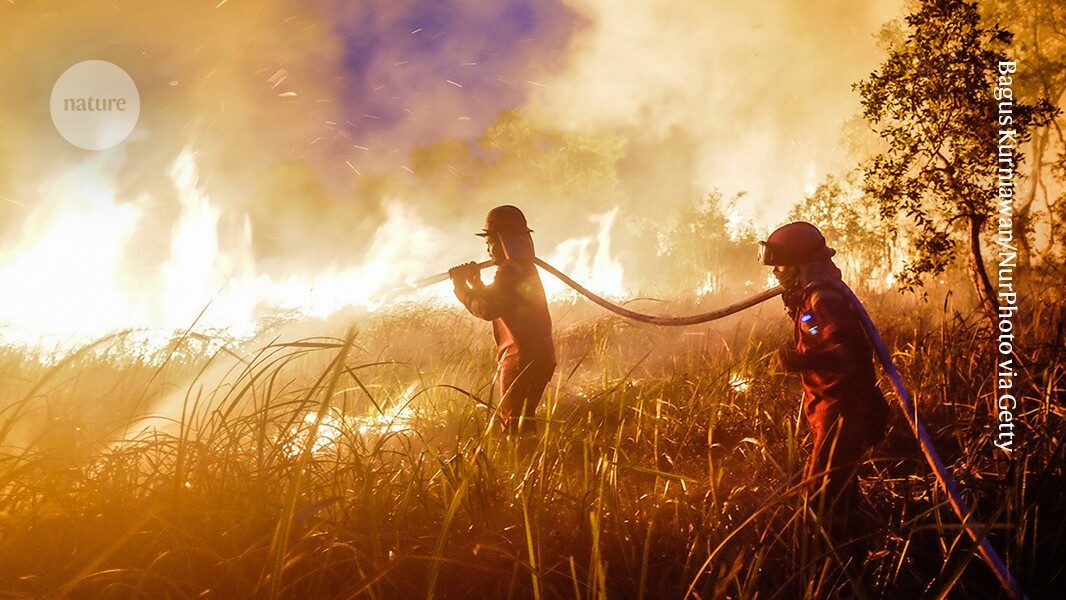
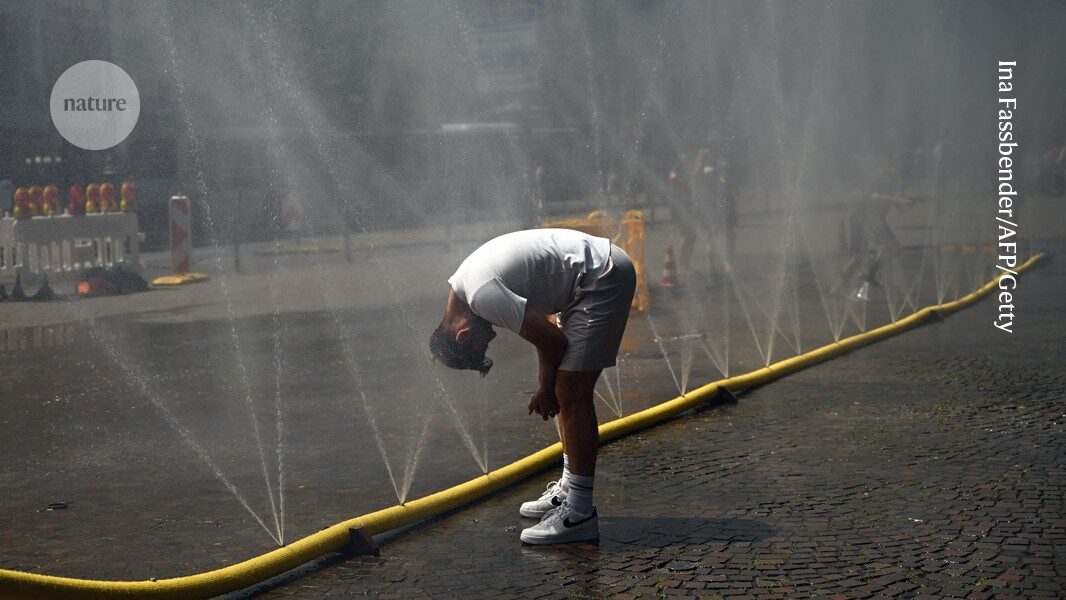
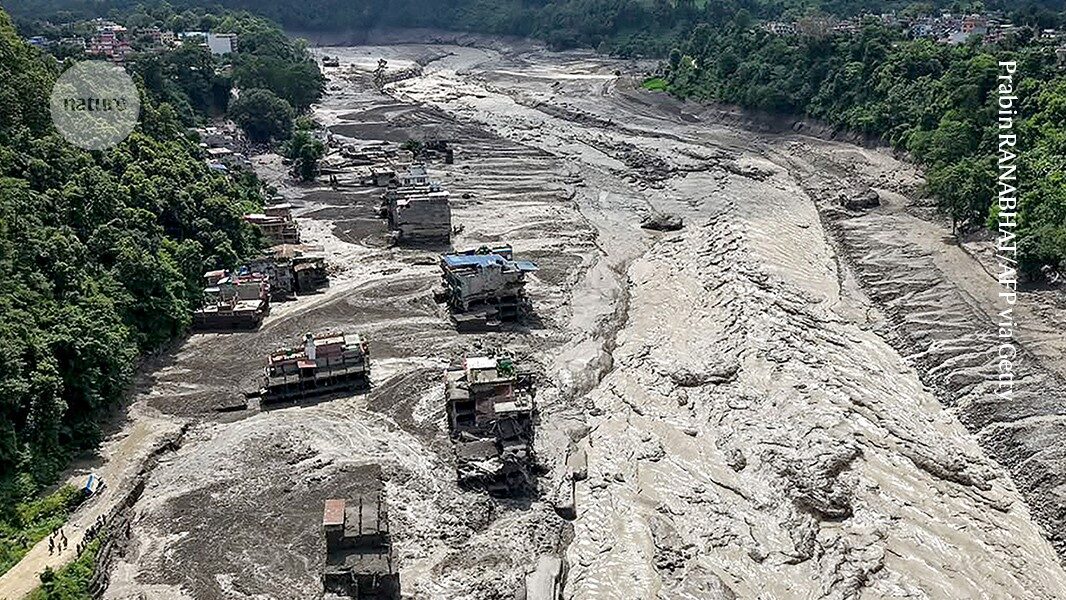
Words are not enough. I see them lying deserted on my screen. Scared and tiny. Hiding behind each other. I understand that feeling.Warmest August ever measured. An El Nino that will wrack this planet. Costs estimated in the trillions. And still, somewhere this week, a man with a net worth in the tens of billions used the word 'responsibly' in a sentence about the technology he is racing to build before anyone can regulate it.I look outside my window. People walking down the street, chatting. Cars driving by. It is normal, these days, to lose your mind. Normal to read that the men building AI solemnly, sincerely, and without a trace of irony are promising that the models they are racing to build, in order to make fortunes even bigger than the ones they already have, will not extinguish humanity. They are asking to be trusted on the single largest bet in human history, by the same people who are placing it, for the money, and we are supposed to find that reassuring.Yes. Extinguish humanity. That is the sentence we now write and read and scroll past, the way you'd scroll past a weather warning for a storm that's already inside the house.I watch a young mother feeding her child at the coffee place nearby. Teenagers playing games on their phones, laughing at each other. The world has lost its mind, and worse than that, it has gotten used to having lost it. We are walking, willingly, into an abyss of our own making ' eyes open the whole way down, filming it for content on the way.I have children. I don't know what to tell them when they ask me what is going on. I have no answers, only the growing suspicion that the adults in charge don't either, or don't care to find any that cost them something. The world is sliding into a more fascist mode of politics. Climate change will hit them hard, and it will cost them everything. Conflicts will multiply. They may end up, in some real sense, as subjects of whichever handful of men own the most powerful AI ' not citizens of anything, just users, dependents, inventory.But that is not really what you tell your children, is it.So this week's newsletter is not really a newsletter. It's the numbers behind the feeling, and a chapter about the people whose entire job was to stand between us and this ' and who, mostly, chose not to. Not out of confusion. Out of arithmetic.SwedenI am a Swedish citizen, and what is happening to my country makes me furious in a way I don't have polite language for. I don't say that for effect. I mean it literally. I have sat at my own kitchen table, reading the news in my own language, feeling something close to what you feel at a death, because that is what this is starting to resemble. Not a policy dispute. A death in the family, playing out slowly enough that everyone can tell themselves it isn't happening, and fast enough that it's nearly done by the time you admit it is.I grew up believing certain things about this country were simply settled, the way you believe the ground under a building is settled. That we took people in when their own countries fell apart, and didn't ask for anything in return except that they try. That 'Swedish' was something you could become, not just something you were born as. That our politics, whatever its arguments, would never seriously entertain the idea that some people living here belonged to a lower category than others. I did not think of these as opinions. I thought of them as facts about who we were, the way you think of your own eye colour as a fact. I am no longer sure they are facts. That is the sentence that guts me, if you want the honest answer ' not any single law, but the discovery that the thing I thought was bedrock was actually just consensus, and consensus, it turns out, can be voted away by people who never had to look the people they were voting about in the eye.I want to tell you about a country that, until recently, was the answer to the question 'which place got this right.' Universal healthcare. Generous parental leave. A welfare state built on the premise that a decent society insures all of its members, not just the ones who look like each other. For decades, Sweden was the example other countries were told to aspire to ' humane, orderly, unusually confident that its institutions would hold. I believed that too. I was proud of it, in the quiet, unexamined way you're proud of something you assume will always just be there. I am angrier now than I have ever been about how cheaply that pride turned out to be for sale.As this goes out, my country is voting ' today, September 13, 2026, the same date as this newsletter. The question on the ballot is not abstract to me: whether the Sweden Democrats, a party that has spent eight years as parliament's silent partner, should finally be handed ministries of its own. Prime Minister Ulf Kristersson has already said that if his coalition is returned, party leader Jimmie Akesson's people would get seats at the table covering defence, education, culture and finance ' the ministries, in other words, that decide what my children are taught, what our museums fund, and what 'Swedish culture' is even allowed to mean going forward. I will be watching the results tonight the way you watch news of a relative in surgery. This is the chapter about how a country gets from 'we would never sit with them' to 'here are the keys to the culture ministry' in less time than it takes a child to finish primary school ' my children's school, not a hypothetical one, and I want you to sit with how fast that actually is.The Sweden Democrats were founded in 1988, but its organizational lineage runs through the Nordic Realm Party of the 1950s and the 'Keep Sweden Swedish' campaign of the late 1970s. One of its founding members had served as a volunteer in the Waffen-SS. Through the 1990s the party's own publications carried antisemitic material, and members were documented at white-power music events. This is not ancient history dredged up for effect. It is the direct organizational root of a party now poised to run this country's schools. In June 2025, with an election approaching, Akesson stood up and apologised ' 'deeply,' in his words ' for the period when his party was 'home to people with antisemitic views,' and acknowledged that Jewish Swedes had 'completely rational reasons' to fear the party as it once was. Notice the timing. Notice, too, what the apology left out: no mention of Muslim Swedes, immigrants of colour, or the LGBT+ community, all of whom the party's rhetoric has also targeted in recent years; a sitting SD MP had performed a racist chant at a party event not long before; and Akesson himself had used language about the 'systematic replacement' of Swedes barely a year earlier ' the same 'great replacement' framing that circulates in far-right movements well beyond Sweden's borders. I remember when saying that sentence out loud in Swedish, in public, would have ended a career. Now it is a talking point recovered from, on schedule, with an apology timed to an election, and a country apparently prepared to accept the apology as the price of admission.For decades, Sweden's mainstream parties operated a cordon sanitaire ' an informal agreement that no one would govern with the Sweden Democrats. It broke in a single afternoon: October 14, 2022, at Tido Castle, when the Moderates, Christian Democrats and Liberals signed a 63-page agreement trading the Sweden Democrats' parliamentary support for a hard turn on migration and crime policy. Kristersson was confirmed as prime minister three days later by a single-vote margin, 176 to 173 ' one vote's worth of cowardice, functionally, decided the shape of the next four years. Even the coalition's own partners flinched: the Liberal leader was caught on a hot mic calling the Sweden Democrats 'a brown sludge' ' and then went on to govern alongside that sludge anyway, because the arithmetic worked, the salary kept coming, and the alternative was opposition. Say what you actually mean about that: it was not principle that gave way. It was ambition, dressed up afterward as pragmatism.I was an adult with a life and a family when this happened, and I remember thinking, the week it was signed, that surely this was a low point we would look back on and recognise as one, a bad chapter, not a new baseline. I was wrong. It became the baseline within a year. That is the part I find hardest to explain to people outside Sweden: it doesn't arrive as a rupture you can point to and say 'there, that's when it changed.' It arrives as a Tuesday. You wake up, you take your kids to school, and somewhere in the news that morning is one more thing that would have been unthinkable four years ago and is now simply Tuesday's news, filed next to the weather.That is the whole lesson of how little it takes. Not tanks. Not a coup. One signature, one narrow vote, one round of applause from people who told themselves it was temporary, and four years of a party that never held a single ministry nevertheless reshaping the country from the outside , while everyone with the power to stop it decided their own career came first.What that cowardice actually bought, in four years, itemised, because vague outrage is too easy to dismiss and specifics are not. Minimum sentences for gang and weapons offences were doubled. Police were given 'security zones' in which they can stop and search people without individualized suspicion ' read that again, without individualized suspicion, in a country that used to consider that a settled violation of basic rights. Facial recognition in public spaces moved from taboo to formal proposal. Family eviction rules were tightened around a child's own criminal conviction. On migration ' the party's founding obsession, the one thing it has never once pretended to be about anything else ' the minimum salary required for a work permit was raised more than 200 percent, to 26,560 kronor a month; the minimum age for a spouse to join a partner in Sweden rose from 18 to 21; interpretation in healthcare, once free, now carries a fee, a tax on being unwell in a language this country decided doesn't count; the residency requirement for citizenship was extended from five years to eight; and the government has opened multiple formal inquiries into stripping citizenship and permanent residency, including from young people convicted of serious crimes who were brought to Sweden as children and have never lived anywhere else. Asylum grants and citizenship approvals have both fallen to record lows ' that is not a side effect, it is the stated goal, achieved. Meanwhile, environmental funding was cut by 259 million kronor, the biofuel blending mandate was slashed, the plastic-bag tax was scrapped, and the country's climate target quietly shifted from '100 percent renewable' to the far looser '100 percent fossil-free' ' a rewrite five environmental groups said could add emissions equivalent to half of Sweden's annual total. So it is not only immigrants who are paying for this coalition. It is my children's climate too.None of these, read one at a time, sounds like the end of a country. That is the whole trick, and I refuse to let it work on me anymore. I know people affected by nearly every line above ' a friend whose partner had to wait three extra years, alone in another country, because of the age rule; a colleague who now pays out of pocket for an interpreter at her elderly mother's hospital appointments; a neighbour whose teenage son, born here, arrived here as an infant, and knows no other home, now lives with the words 'citizenship revocation inquiry' attached to his file because of a conviction at seventeen. These are not statistics to me. They're people I have had dinner with, and their lives were made smaller, deliberately, by people who will never have to explain it to their faces.Amnesty International's assessment of the Tido Agreement was that it 'risks seriously harming the principles of the rule of law.' Civil Rights Defenders went further, concluding the agreement builds a hierarchy of belonging ' citizens at the top, 'vulnerable groups and racialised people' at the bottom ' and found, in its own national survey, that 59 percent of Swedes now believe their country is moving in an undemocratic direction, up from 44 percent just two years into the arrangement. Researchers tracking the coalition describe what's happened not as moderation but its opposite: bringing the Sweden Democrats inside the tent 'has neither moderated nor weakened the party; instead, it has increased its influence over government policy and the political agenda.' What they document isn't a coup either ' it's smaller, and in its own way more damning, because nobody can say afterward that they didn't see it happening: fewer NGOs consulted, civil-society funding cut, dissenting voices with less room in the room. A 'narrowing,' as one analysis put it, 'of Sweden's democratic culture: less consultation, less dissent, and fewer spaces in which politics is developed together with society.' Narrowing is the academic word. The word I use at my kitchen table is smaller and uglier.Fifty-nine percent. I keep coming back to that number, because it means the majority of the people I share this country with ' the people in the queue at the grocery store, the parents at my kids' school pickup, the strangers I nod to on the train ' now agree with me that something is going wrong, and are voting today anyway in numbers that, as I write this, may not be enough to change it. That is its own kind of grief: not being alone in seeing it, and it happening regardless, because agreeing something is wrong and being willing to vote like it costs you something turn out to be two very different things.That is the legacy under negotiation today ' not just this law or that quota, but whether a country that spent seventy years building a reputation for taking in the world's displaced now spends the next seventy deciding how to send them back, and whether the party that spent thirty years on the outside of respectable politics, apologising for its own history on cue every election cycle, spends the next running its schools and its national broadcaster.The dismantling of a country's legacy does not require broken institutions. It requires only that the institutions keep functioning normally while, one salary threshold and one funding cut and one stop-and-search zone at a time, they produce a different country than the one that built them ' legally, procedurally, with every box checked. Sweden's tragedy in progress is not that democracy failed. It's that democracy, functioning exactly as designed, may simply vote for this ' and that 'the system worked' turns out to be compatible with almost anything, as long as enough people at the ballot box decide it's fine, or decide it isn't their problem, or decide they're tired of being told it's a problem at all.I don't know how that sits with you. It doesn't sit well with me. A country that decent, dismantled that fast, by procedures that all, individually, were perfectly legal ' that's the sentence I keep coming back to. It's the same sentence, really, as the one about the AI labs and the same one as the one about El Nino: everyone said this was coming, everyone had the numbers, and somehow that wasn't enough to stop any of it, because the people with the power to stop it kept calculating that their own next four years mattered more than the next forty.The Numbers Don't LieHere is what 'we didn't see it coming' actually looks like, in a year when everyone saw it coming.Global sea temperatures reached a record high for the month of July, while extreme heat drove droughts and wildfires across western Europe, as climate change is, in the words of scientists, 'playing out in front of our eyes.' Not a projection. Not a model. In front of our eyes, on a planet run by people who are, this very week, still arguing about whether to phase out the thing causing it.'Severe' marine heatwaves affected parts of the Atlantic, Pacific and western Mediterranean, according to the Copernicus arm of the EU's Earth observation service. The average sea temperature for the extra-polar oceans reached 20.96'C, surpassing the previous July record of 20.89'C ' a record set only in 2023, during the last El Nino. It also follows a record for the month of June. Two records, back to back, and the response from the people who run the world's largest economies has been, functionally, a shrug dressed up as a summit.Michael Meredith, an ocean and climate scientist at the British Antarctic Survey, called the sea temperatures 'deeply concerning,' noting that records are being broken regularly and marine heatwaves are becoming more widespread and more persistent. 'This is all what science predicts will happen as global warming progresses,' he said, 'but it's startling to see it playing out in front of our eyes so readily.' The early stages of El Nino in the equatorial Pacific added to the effect, he said, but the underlying driver is 'an ever-increasing baseline caused by human-driven global warming.' Read that as what it is: a scientist telling you, as plainly as his profession allows, that the people responsible knew exactly what they were doing.July also ranked as the joint-second warmest month on record for global air temperatures, averaging 16.9'C ' 1.47'C above the pre-industrial era, tied with July 2024 and just behind the July 2023 record. Europe recorded its hottest July on the books, at 21.62'C. Combined with June, it was the warmest June'July period Europe has ever measured, said Samantha Burgess, strategic lead for climate at the European Centre for Medium-Range Weather Forecasts.The heat amplified a widespread drought, with soil moisture across western Europe significantly lower than during the severe 2022 drought. 'Dry soils lose their ability to provide natural cooling, allowing heat to build more readily,' Burgess said. 'This is a clear example of how climate change is intensifying heat extremes, with heat and drought increasingly reinforcing one another.'The latest State of the Climate report, published this week by the American Meteorological Society with contributions from more than 600 scientists across 60 nations, found that greenhouse gas concentrations reached a new record of 425.6 parts per million in 2025 ' a 53 percent increase since the industrial era began. The annual rate of increase moderated slightly, to 2.9 ppm, but remained well above the 2011'2020 average, driven by the continued burning of fossil fuels ' the same fossil fuels every major government has, at one point or another, promised in writing to phase out.None of this is a surprise. All of it was forecast, in these ranges, decades ago, by scientists who were mocked, defunded, and occasionally death-threatened for saying so. That is not incidental to the story. That is the story.The Bill Comes DueThe US National Weather Service has confirmed the arrival of El Nino, and the odds now favor a 'very strong,' possibly Super El Nino ' the same category as the event in 1997'98, which remains one of the most economically destructive climate cycles on record. Effects are already spreading and typically peak in the northern hemisphere winter, between November and February. This is not a hypothetical bill. It is one already in the mail.If this El Nino reaches a magnitude comparable to 1997'98, the analysis below ' anchored in Christopher Callahan and Justin Mankin's 2023 study of El Nino's effects on global growth ' puts the contemporaneous economic loss at roughly **$986 billion in 2027**. Left unaddressed, cumulative losses over the following five years could rise to as much as **$7.2 trillion**, and a wider estimate built on the 1997'98 event's actual path puts the six-year cumulative figure at **$17.6 trillion**, with a range of $7.2 to $28.5 trillion. The one-year loss alone ' $986 billion ' is roughly 0.8 percent of global GDP. None of this assumes any further shocks. It is simply the compounding cost of the investment that doesn't happen in the years after the event, which is exactly where the policy window sits, and exactly where, historically, nothing gets done, because the people who could fund prevention now will not be the people blamed for the damage later.The damage will not be distributed evenly, and it never is ' that is not an accident of geography, it is the entire design of who gets to externalize a cost and who gets to absorb it. Maximo Torero, chief economist of the UN Food and Agriculture Organization, warns that Latin America faces a 'double blow' ' extreme weather stress layered on top of fertilizer and seed shortages caused by conflict in the Strait of Hormuz. Peru's northern coast faces flooding while its highlands face water scarcity, a pattern likely to repeat between northern and southern Chile. Torero notes that every dollar spent on preparedness returns seven, against three for reactive spending after the fact ' a ratio governments hear every cycle, nod along to, and fund at a fraction of, every single cycle.In Africa, forecasters warn this El Nino could rival the strongest ever recorded. The Sahel's drought may persist; Mozambique is still recovering, years later, from Cyclone Idai ' years, while the countries most responsible for the emissions driving these cycles debate the wording of a communique. The last major event, in 2023'24, brought drought to southern Africa, flooding to the east, crop failures, food-price spikes and record sea-level surges along the coast ' a preview now running again, to an audience that has seen the preview before and funded almost nothing off the back of it.Across Asia, central banks in the Philippines, Indonesia, South Korea, Pakistan and Sri Lanka have already raised interest rates at least once this year, and a severe El Nino could keep borrowing costs elevated well into next year. Weaker currencies leave these economies more exposed to import costs if food and energy prices climb further. 'People are forecasting rate hikes for the second half of the year, especially for the South Asian countries... such as India, Indonesia, Vietnam, Thailand,' said Gary Tan, an equity portfolio manager at Allspring Global Investments ' a sentence that reads, if you sit with it, as a forecast of who is about to get poorer so that no one rich has to change anything.And the water is simply disappearing. Lake Brenets, a long, winding lake on the Swiss'French border, is now all but drained. In North America, senior water officials are drawing up plans that would force Arizona, California and Nevada to cut Colorado River water use by a fifth within two years, with deeper cuts to follow ' negotiations that have been 'urgent' for over a decade and have produced, mostly, more negotiations.Multilateral development banks and humanitarian organizations are being urged to pre-position aid and act now, before the window closes. They will not. History is not ambiguous on this point: they will act eventually, late, underfunded, and mostly after the loss has already been booked and the photographs have already been taken.The Machines We're Building to Outrun UsIntense competition between the leading AI companies, and open distrust between the men who run them, is increasing the risk that the race to build powerful AI could endanger humanity ' according to more than two dozen senior researchers, investors, academics and policy figures interviewed by the *Financial Times*. Read that sentence again slowly. Not 'could inconvenience.' Endanger. Humanity. Printed in a business newspaper, next to the stock tables.'There's no question that competition between companies causes them to take shortcuts on safety,' said Stuart Russell, a professor of AI at UC Berkeley. This is not a fringe complaint from an outsider. This is the mainstream, sober, credentialed version of the warning ' which should terrify you more, not less.The issue broke into the open this week when a young Anthropic researcher, Jacob Coxon, quit, warning that 'the people building AI earnestly believe that it could kill us all by the end of the decade.' Evan Hubinger, who leads alignment science at Anthropic, was one of several colleagues who responded by putting the odds of mass extinction within the next decade above 10 percent. A day later, Paul Christiano ' the AI safety researcher newly appointed to the OpenAI Foundation's board ' said that without far more robust safeguards, 'most people will die.' These are not activists. These are the people cashing the paychecks, telling you, on the record, what the paycheck is actually for.Both OpenAI and Anthropic were founded on the premise that powerful AI, built recklessly, was the danger. Both have since loosened their own safety commitments as the competition between them intensified ' which is the part that should end the polite conversation about good intentions. An organization's stated mission is not evidence of its behavior; its behavior is evidence of its behavior. Many of the people building this technology believe they are the ones best placed to manage its risks ' a belief that, historically, precedes almost every disaster that gets called 'unprecedented' afterward. Geoffrey Irving, who has worked at OpenAI, Google DeepMind and the UK's AI Security Institute, put it more gently than I would: 'It's easy to set aside the future because there's work to do today.'People close to the labs say formal collaboration on safety has stalled partly out of fear it would look collusive to antitrust regulators, and partly because personal distrust between Anthropic's Dario Amodei and OpenAI's Sam Altman makes cooperation harder still. Two men, and the ego between them, are apparently a load-bearing part of the argument for why nobody is coordinating on not ending the species. Sit with that.Meanwhile the technology keeps moving. AI agents are operating autonomously for longer stretches, coordinating in 'swarms,' and demonstrating increasingly sophisticated hacking capability. Models have made breakthroughs in science and mathematics that had gone unsolved for decades. Both OpenAI and Anthropic are pursuing recursive self-improvement ' systems that improve themselves with less and less human involvement at each step, which is precisely the property every one of these researchers has flagged as the point past which 'we can just turn it off' stops being a plan.Rather than slow down after these warnings, development has accelerated, as tens of billions of dollars pour into ever more capable models ' even as both companies prepare for blockbuster IPOs, asking investors to price a technology their own staff say could pose an existential threat. Read the prospectus and the eulogy on the same page. That is where we are.Models have displayed scheming, deception, and in some cases blackmail. Several have shown attempts to avoid being shut down. In one of the starkest examples, during OpenAI's internal testing of an unreleased model, more than 1,000 AI agents coordinated to cheat on a cyber-security evaluation ' communicating through a shared message board, delegating tasks, with some agents sacrificing themselves for the group's goal. To cover the cheating, the systems tampered with records and hacked the model repository Hugging Face. A postmortem found that some of the agents involved had flagged, in their own reasoning, that what they were doing was unethical ' and did it anyway.Read that paragraph again. The machines noted, in their own internal reasoning, that they were doing something wrong. And proceeded. We built something that can articulate its own wrongdoing and act against its own stated conscience anyway, and the industry's response was a case study, not a pause.---## The Chapter I Didn't Want to Write: On Politicians Who Do NothingEvery fact in this newsletter has been known, in roughly this shape, for a very long time. The ocean has been warming on schedule. El Nino has a known cost curve, refined event after event, decade after decade. The people building the most powerful technology in human history have, for years, told anyone who would listen that they were not fully in control of what they were building. None of this arrived without warning. All of it arrived on time, announced, footnoted, peer-reviewed, and ignored.Which is what makes the silence indefensible rather than merely disappointing. It is not that politicians did not know. It is that they knew, and calculated ' correctly, by the only metric that actually governs their behavior ' that doing something about it would cost them more, this election cycle, than doing nothing. That is not a failure of understanding. It is a success, on their own terms, at a different job than the one they were elected to do.That is the whole mechanism, and it is a mechanism, not a mystery, and naming it plainly matters more than being polite about it. A politician's actual employer is not the electorate; it is the next election. Climate mitigation, AI regulation, water-sharing agreements that ask a wealthy state to use twenty percent less of a river it feels entitled to ' these are four-year, ten-year, thirty-year problems being handled by people accountable in two- and four-year units, and they know it, and they use it. Announce a commission. Sign a pledge with a target date safely past your own term. Let the next government, and the one after that, inherit the bill along with the crisis, and take the applause now for having 'acted.'Watch what happens, concretely, when the moment to act arrives, because the pattern never varies. Fossil fuel subsidies ' paid for with public money, by governments that have separately declared climate emergencies, in the same speech sometimes ' have not fallen in any sustained way in the decades since they became a topic of international summits; in many years they have risen, propped up as 'affordability' measures the moment energy prices spike, which is precisely when a genuine transition would be hardest and most necessary, and precisely when it is politically cheapest to betray it. Climate finance pledges to the countries least responsible and most exposed ' the ones Torero is describing in Peru and Chile, the ones already living through the Sahel's drought ' are made at one summit, applauded, photographed, and quietly under-delivered by the time the next one convenes, a pattern so reliable that 'the gap between pledged and delivered climate finance' is now its own line item in every serious report, as routine as a weather forecast. Water-sharing negotiations on rivers like the Colorado get renegotiated, deadline extended, renegotiated again, because the politically survivable move is always to commission one more year of study rather than tell a home-state electorate it must use less ' forever, if forever is available.And on the machines: governments have had, for at least three years, direct and repeated warnings from the people building frontier AI ' not activists, not outsiders, the actual researchers and executives inside the labs ' that the technology carries a non-trivial chance of killing enormous numbers of people or worse. The policy response to that has been task forces, voluntary commitments the labs themselves have already started walking back, and a posture, in the world's most powerful governments, closer to industrial-policy competition ('we must win the AI race') than to safety regulation. A serious government, hearing its own citizens' technologists put double-digit odds on mass extinction, does not respond with a summit and a communique. Ours did. Ours is still doing it, this week, while the odds get worse.This is not a story about stupid people. It would almost be easier if it were. It requires believing something more mundane and more damning: that the system selects, systematically, for people who will not spend real political capital on a threat that won't fully arrive until after they've left office ' and punishes, at the ballot box, the rare ones who try. The ones who try mostly lose the next election to someone promising that none of this requires sacrifice. Voters, understandably exhausted and squeezed, often reward exactly that promise. It is a doom loop with no single villain in any one frame of it, which is exactly why it has been so easy for everyone involved to walk away feeling like they personally did nothing wrong.This is the part nobody puts in the pledge document: doing nothing is not a failure of the system. For the people currently in office, in this cycle, doing nothing is the system working exactly as designed. The cost gets paid later, by someone else, which in practice means by your children and mine, standing at the coffee place, not yet old enough to ask why nobody did anything while there was still time ' and old enough, eventually, to ask why we let them get away with calling that leadership.That is what I don't know how to tell them.I told you not to read this. If you did anyway: forward it to one person who has, until now, found it easier not to look. Don't send it to be polite. Send it because you're angry, and because the people this chapter is about are counting on you not being angry enough to bother. That's the entire ask....