My previous post dealt with one vision of socialism, a society where people work for the fun of it and give away what they produce. It exists in the real world on a small scale embedded in a market society. My family will be hosting a meetup in our house in about three weeks at which we will provide all comers with food, drink and space for conversation, all at no cost. We will make most of the food ourselves ' we like cooking ' but with purchased ingredients. We bake our own bread but do not grow our own wheat or grind our own flour nor do we know anybody who does and is happy to give us some. The centralized form of voluntary socialism appeals to my imagination less but comes closer to working.1 Israeli kibbutzim range in size up to a thousand inhabitants. The oldest is more than a century old and monasteries, an earlier version of the same model, have lasted much longer. There are at least three reasons. The first is ideology, religion for the monasteries, socialism for the kibbutzim. That is a reason for people to donate their labor and money to the project but also a constraint on how the institution is run. Celibacy and poverty were important elements in the ideology of many monasteries but made them less attractive to many potential recruits. Equality of income was central to the socialist ideology and policies of the original kibbutzim but the source of a variety of problems for them....
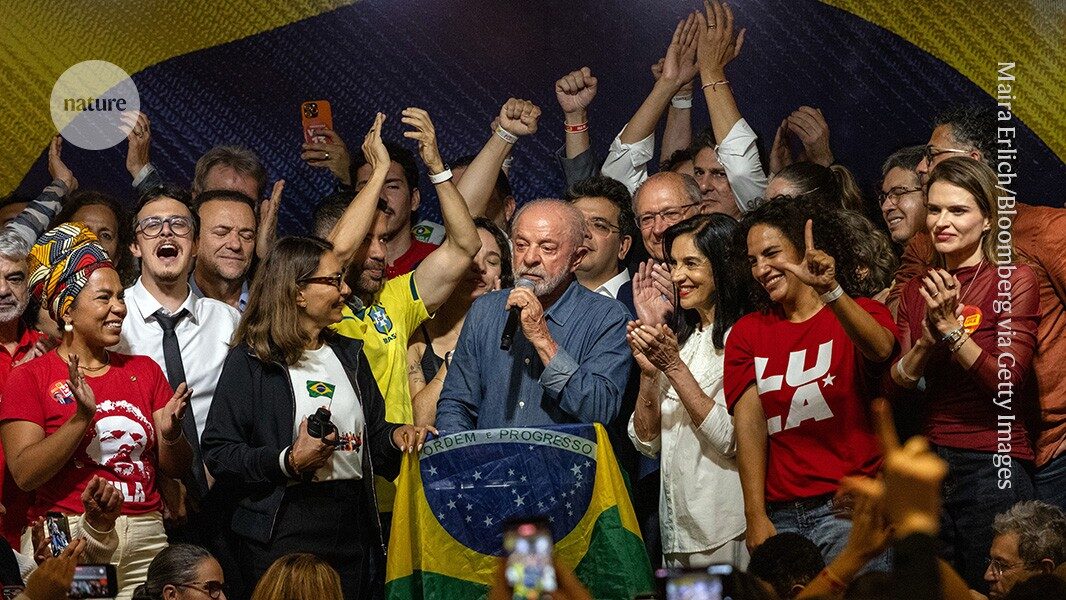
Brazil's President Luiz Inacio Lula da Silva won his bid for re-election on 25 October, to the relief of many scientists who feared for the future of Brazilian research if right-wing candidate Flavio Bolsonaro prevailed. In recent weeks, some of Brazil's leading scientific organizations, including the Brazilian Academy of Sciences in Rio de Janeiro, circulated an open letter endorsing Lula, a leftist former labour leader. It received more than 20,000 signatures. 'It's hard to express just how happy the scientific community and the Brazilian society is with Lula's victory,' says Paulo Artaxo, a physicist at the University of Sao Paulo. Many worried that, if Bolsonaro were elected, he might slash support for Brazilian science and undermine it in the way that his father, Jair Bolsonaro, did. Jair was Brazil's president from 2019 to 2023, and during that time, he cut science funding and expressed anti-science rhetoric during the COVID-19 pandemic, casting doubt on vaccines and promoting unproven treatments. The former president could not run for office again because he was sentenced to prison over a coup plot that he instigated after he lost his bid for re-election to Lula in 2022. He is currently serving the sentence at home because of health concerns....

Good morning & happy Monday! Today, we're diving into why JPMorgan, Bank of America, Citi, Wells Fargo & Morgan Stanley are locking AI agents out of customer accounts, and why customers who let them in may now carry the losses (what the Axios scoop got wrong, why the blocks started a week before it, how Regulation E turns a shared password into a liability transfer, which blocking banks are helping design Meta's official way in, & the one signal that would end the blockade + bonus deep dives into How AI Agents Reshaped Jobs, Hiring and Productivity at Anthropic & How to Hire a Grok Bot: Your First AI Employee inside), and breaking down Visa's rumored $2.5B bid for Fireblocks to see why the card giant wants the crypto custody firm for the one thing a Visa takeover would end: its neutrality (what Fireblocks' denial does and doesn't rule out, why the price sits 69% below its 2022 valuation and who would take the loss, the stablecoin network gap Visa can't close quickly on its own, & what to watch next + bonus deep dive into The Ultimate List of Stables Resources inside). So let's jump straight into the finnovative stuff ''...