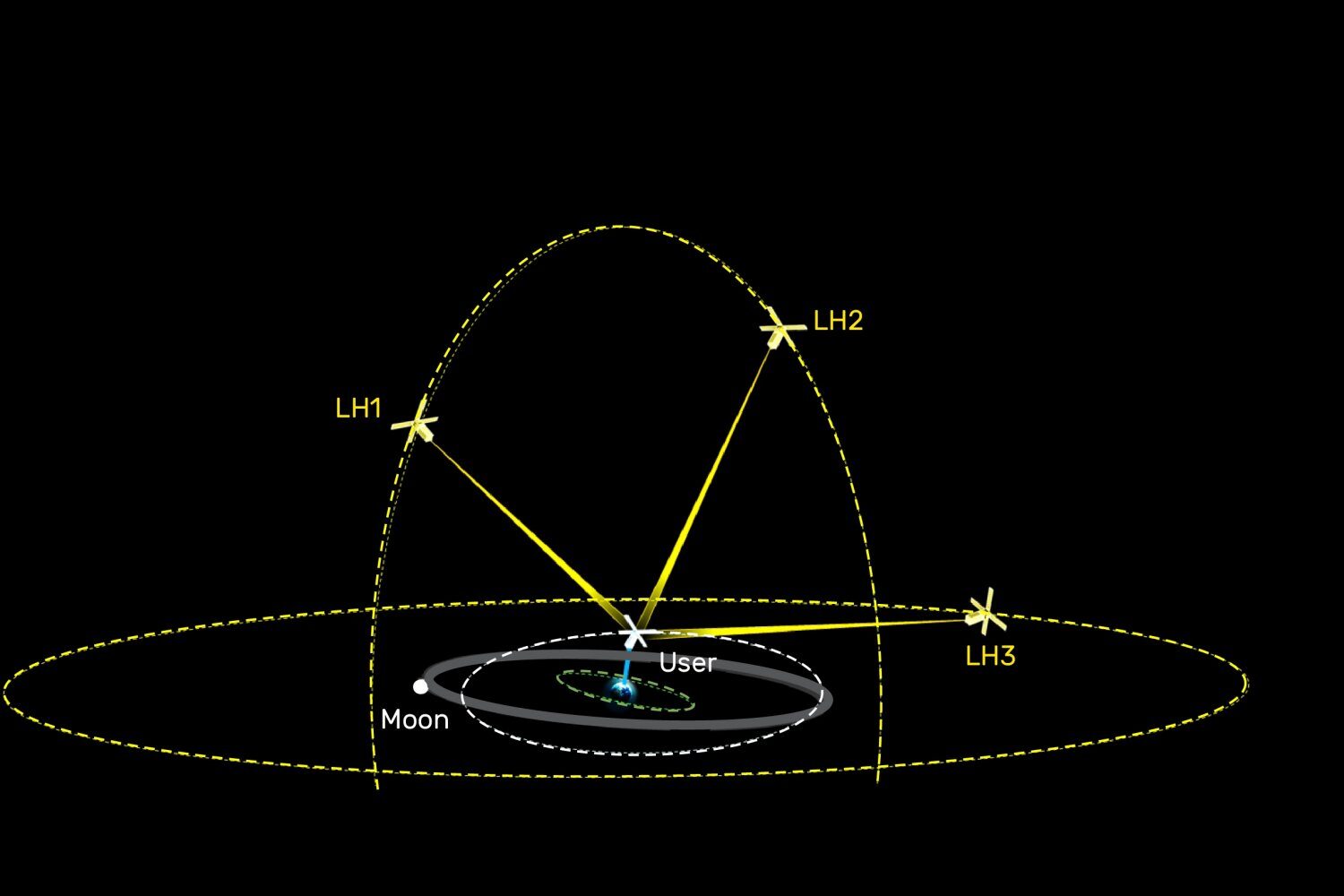
On Earth, the processes behind navigation are made nearly invisible by global positioning satellites (GPS). In cislunar space ' the region between Earth and the moon ' spacecraft do not have that kind of always-available positioning service. Missions beyond geosynchronous Earth orbit still rely heavily on NASA's Deep Space Network (DSN), an accurate but limited Earth-based international array of radio antennas shared across many missions and nations. Because all DSN sites are located on Earth, their separation is small compared with the scale of cislunar space, which limits the angular baselines available for orbit determination. Therefore, precisely estimating orbits for distant spacecraft can take hours, and DSN supports only a few missions at a time. In addition, DSN requires user spacecraft to actively emit signals for measurement, unlike GPS, which passively sends data for users to receive. The Laser Communications Group and Advanced Capabilities and Technologies Group at MIT Lincoln Laboratory are developing a concept called the Light High-Orbit Utility Signal Emitter (LightHOUSE) to help overcome these limitations. LightHOUSE would use a small constellation of satellites in high-altitude orbits as cooperative optical beacons. These beacons would exchange timing and communication signals with user spacecraft and use imaging against the stellar background to estimate each spacecraft's three-dimensional position and velocity. By providing timely, independent navigation data across cislunar space, LightHOUSE could reduce the need for corrective maneuvers, preserve spacecraft propellant, lessen the burden on onboard navigation sensors, and ease demand on existing ground-based systems....

A grab bag of funded startups caught our attention this past month, from a previously bootstrapped custom metal manufacturer that got its first outside funding from big-name Silicon Valley backers, to a startup that aims to provide geothermal energy from underwater volcanoes to small island nations. Let's take a look. Reno, Nevada-based SendCutSend said last month that it has raised $110 million in funding led by brothers and Stripe founders John and Patrick Collison, along with Sequoia Capital and Paradigm, at a reported $1 billion valuation. The company operates an on-demand manufacturing platform specializing in custom-cut metal and fabrication. The round is its first venture investment, and apparently came only after Sequoia's Andrew Reed flew to Reno to woo SendCutSend CEO Jim Belosic into accepting Silicon Valley backing. Previously, Belosic had bootstrapped the company, founded in 2018, with personal savings, bank loans and credit cards, he told The Wall Street Journal. He held little interest in taking cash from startup investors until SendCutSend started to be flooded earlier this year with orders from AI-driven industries including robotics and data centers, and Belosic said he realized the business needed outside investment to grow....

Before boarding Air Force One, White House staffers and reporters had to surrender various items collected during the trip, including staff burner phones, credential badges, and lapel pins issued by China. Those traveling on Air Force One threw those objects in a bin at the bottom of the plane's stairs, according to a journalist in the White House press pool. Photos from the trip show several people in the U.S. government delegation, including Trump, White House communications director Steven Cheung, Apple chief executive Tim Cook, Nvidia's Jensen Huang, and Secret Service agents, all sporting pins on their coat lapels. Goodin did not explain why officials and reporters had to throw away those items, though presumably for security reasons. While the summit appeared cordial, China remains a key adversary of the United States, given its advanced intelligence and espionage capabilities. The U.S. and its allies have long accused China of spying and carrying out cyberattacks. It's not far-fetched to believe some of the gifted items could be bugged, as governments have done before. It's also reasonable to assume the burner phones were likely targeted during the trip. Burner phones are designed to be new and dedicated devices that can be used where attacks can be assumed and later thrown out....

Good morning & happy Tuesday! Today we're diving into AI giants OpenAI & Anthropic, which just outsourced their sales teams to private equity (breaking down their PE playbook, why it matters & what to expect next + bonus deep dives into OpenAI that wants to build the last App Store while also developing a personal AI CFO, & Anthropic's AWS strategy), and a 3-year-old firm nobody's heard of that just bought the world's largest corporate travel company (why Long Lake Management is acquiring Amex GBT, and what it means for Ramp, Brex and Navan + bonus deep dives into American Express and why it skipped the Agent Protocol wars & Anthropic, which just told founders exactly what AI products to build in 2026). Let's jump straight into the fascinating stuff '' On the same day, OpenAI and Anthropic each finalized & signed joint ventures with the biggest names in private equity - TPG, Blackstone BX 0.00%', Goldman Sachs GS 0.00%', and Bain Capital - to physically embed their engineers inside thousands of portfolio companies....