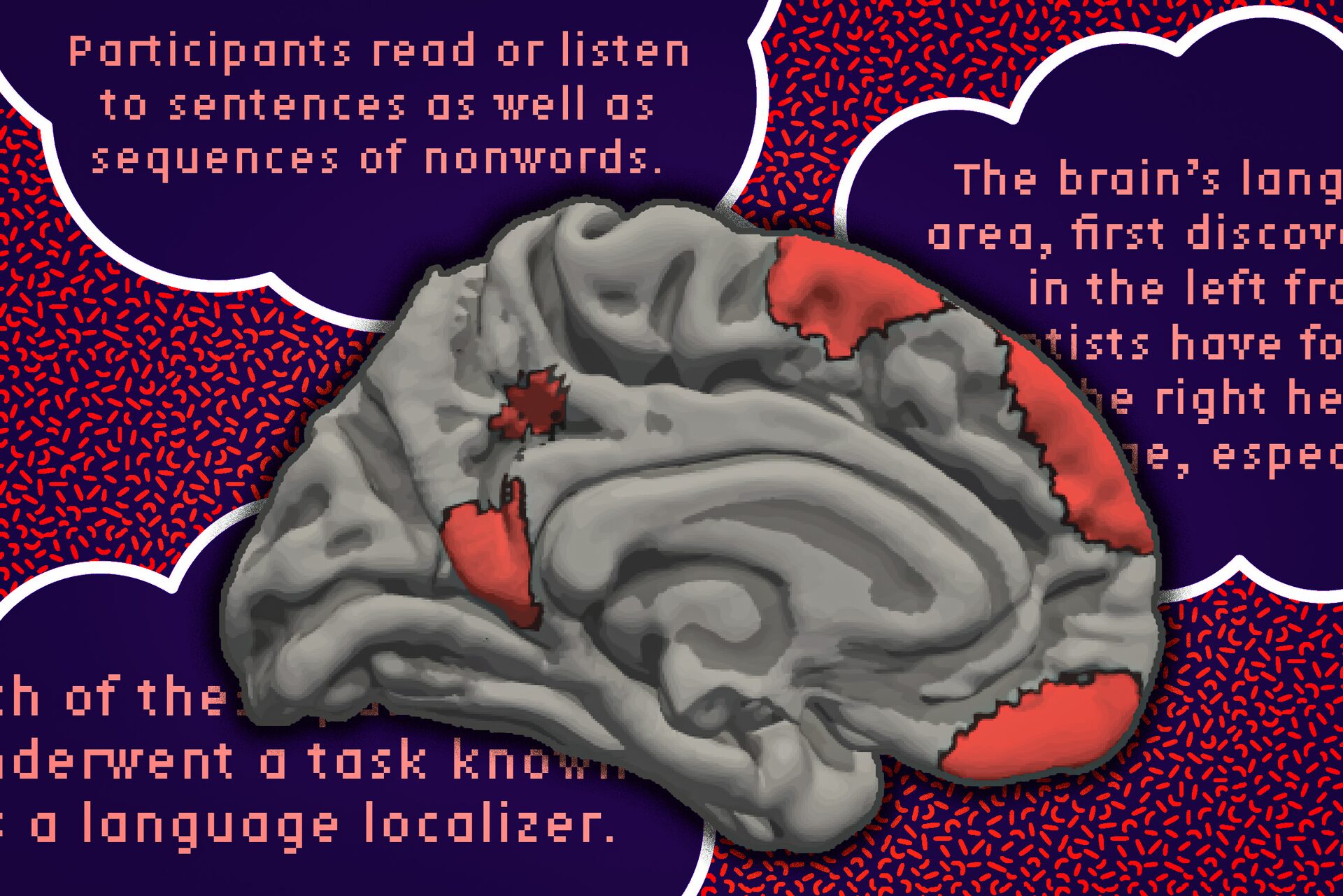
For decades, neuroscientists have known that specific regions in the brain's left hemisphere are responsible for processing language. However, a new study by MIT researchers shows that language processing also occurs in many other parts of the brain. Using functional magnetic resonance imaging (fMRI) data from more than 700 people, the researchers identified 17 additional regions of the brain that appear to play a role in language. These regions are scattered across the brain, including parts of the cerebellum, hippocampus, and cerebral cortex, and they make up about 5 percent of the total volume of the adult brain ' about the size of a large strawberry. 'Even though there are all these distant components, it's pretty restricted in terms of volume. You don't need that much of the brain to do language,' says Evelina Fedorenko, an MIT associate professor of brain and cognitive sciences, a member of MIT's McGovern Institute for Brain Research,and the senior author of the study. Exactly how these regions contribute to language processing is still to be discovered, although the researchers have made some progress toward determining the functions of the cerebellar regions that they identified....
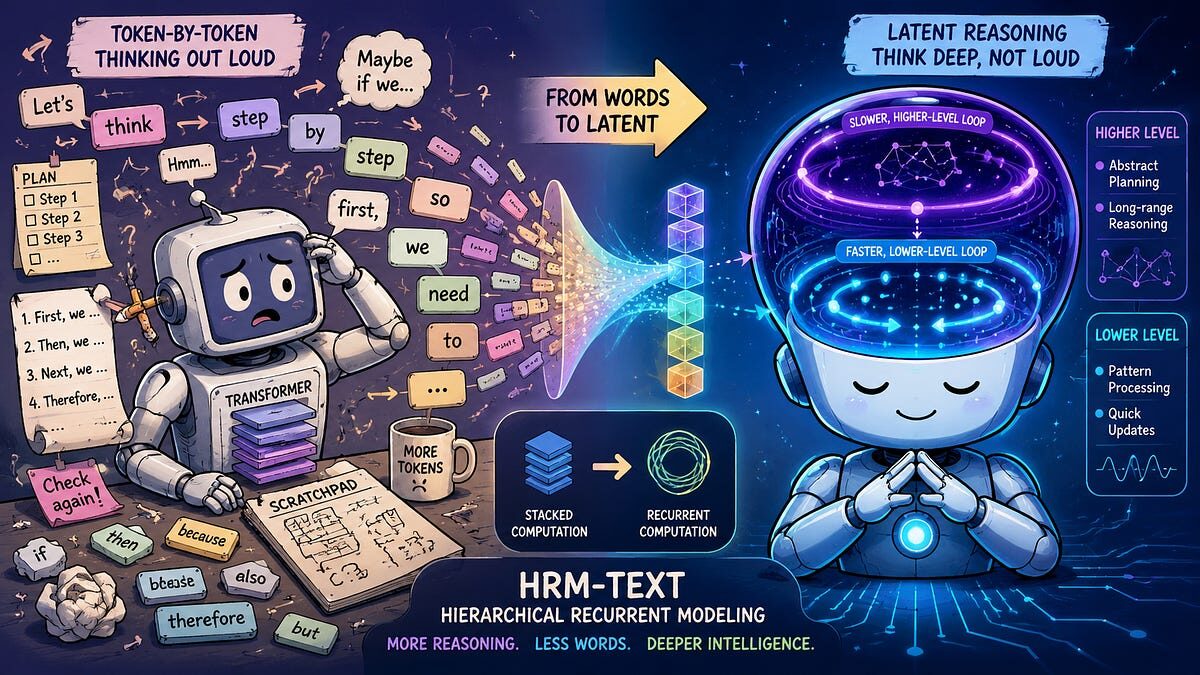
There is a particular sleight-of-hand at the heart of modern LLM reasoning that, the more I look at it, the more it bothers me. The argument goes like this: Transformers are shallow. A 70-layer stack is fixed depth ' it sits in complexity classes like AC' or TC', which is a polite way of saying it cannot, in a single forward pass, solve problems that fundamentally require sequential computation. So we paper over this by making the model think out loud. We give it a scratchpad. We call it Chain-of-Thought. We celebrate. But CoT is not reasoning. CoT is the model renting depth from its own output tokens. Every reasoning step has to leave the residual stream, become a discrete token in a vocabulary built for human communication, and come back in through the embedding layer for the next step. It is, mechanically, an absurd way to do internal computation ' like a CPU that must spill every intermediate register to disk in plaintext English. Sapient Intelligence's bet, made first with the original Hierarchical Reasoning Model paper last summer and now extended into the language domain with HRM-Text, is that this is fixable. Not by making the model bigger, not by training on more CoT traces, but by giving the architecture the one thing it doesn't have: variable, internal, depth. Reasoning that happens in the latent space, not in the token stream....

For a long time, Representative Thomas Massie confidently defied an ironclad law of modern Republican politics'that to oppose President Trump was to start a ticking clock on your electoral career. 'I'm not worried about losing,' he told me last spring inside the Capitol, as he explained to a group of reporters the strength of his support within his Kentucky district. Massie had already angered Trump just a few months into the president's second term, after clashing with him during his first. Massie voted against government-funding bills, criticized the president's tariffs, and would soon become one of the only Republicans in Congress to oppose Trump's One Big Beautiful Bill Act, which the fiscally hawkish Massie deemed irresponsible. Trump lashed out at Massie and vowed to find a primary opponent to defeat his bid for an eighth term; as early as last summer, the president's allies stood up a political-action committee to run ads attacking Massie in his district. Still, Massie refused to fall in line. Over the next several months, he condemned Trump's military adventurism, including his unilateral attacks on Iran, and he helped lead a remarkably successful bipartisan effort to force the administration to release its trove of files on the disgraced financier and convicted sex offender Jeffrey Epstein. Massie, an iconoclast to his fans and an ineffective gadfly to his detractors, had always gone his own way in Congress. Maybe he believed he was uniquely positioned to withstand a Trump-backed barrage. Or perhaps he knew he was toast and had resolved to go down on his own terms....
My senior seminar on the reactionary right has now come to an end. The honest truth is that I'm not very happy with how the class unfolded. It was a mixed bag. Some of the readings were illuminating, as were some of our discussions in class. But at least half of the readings disappointed me, and I would say the same about how the students responded to those readings. I can't say I blame them. This was a collection of grim, angry, embittered authors and texts often motivated by imperfectly processed resentments. In what follows, I will begin by laying out the conceptual assumptions behind my choice of readings and themes for the course. Then I'll list the authors and texts I assigned. From there, I'll discuss those that really failed to impress me'that is, those I would not teach again. Then I'll close by highlighting the best things we read and thought about in the class'and how that has changed the way I assess the reactionary impulse in politics....