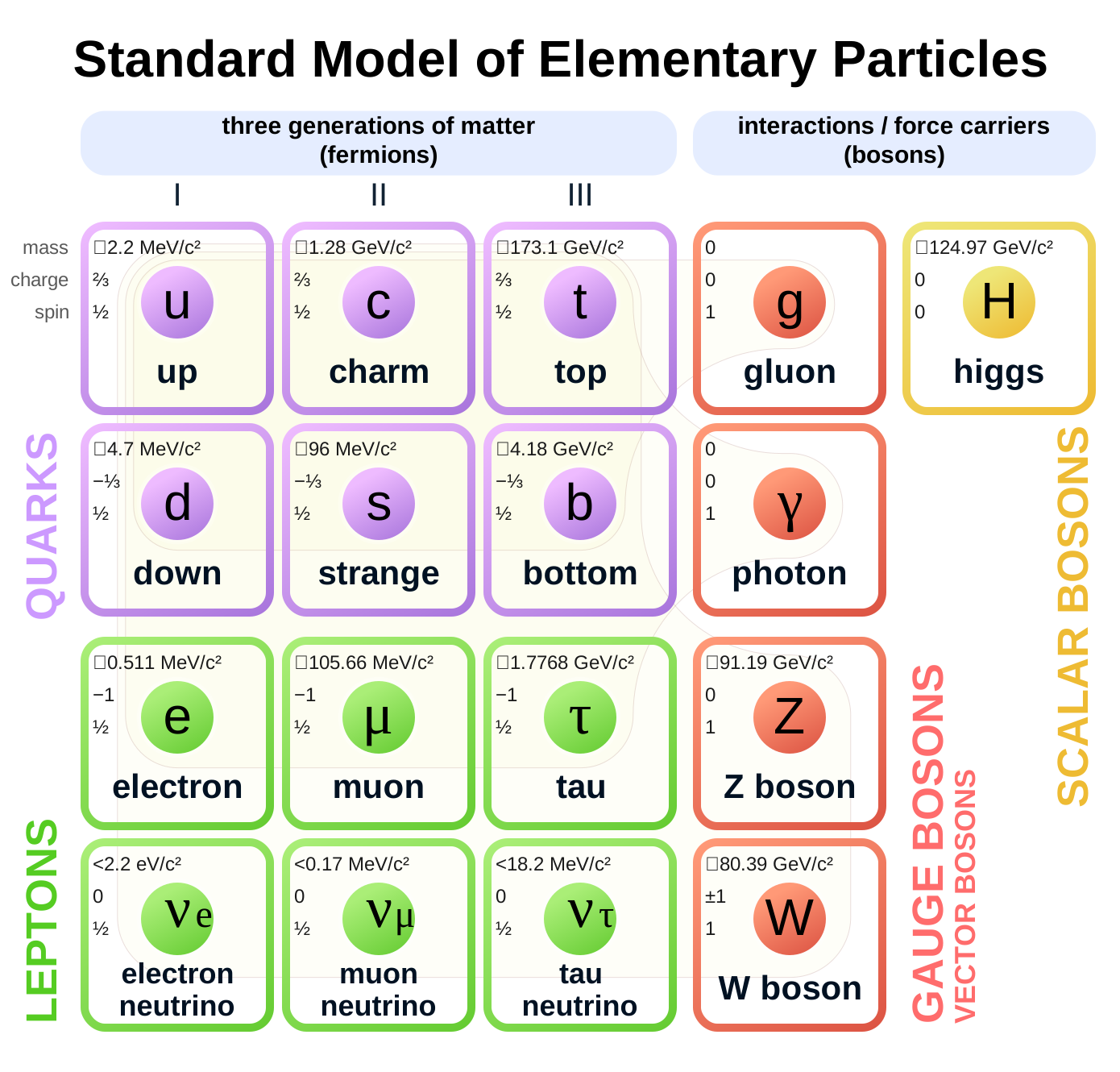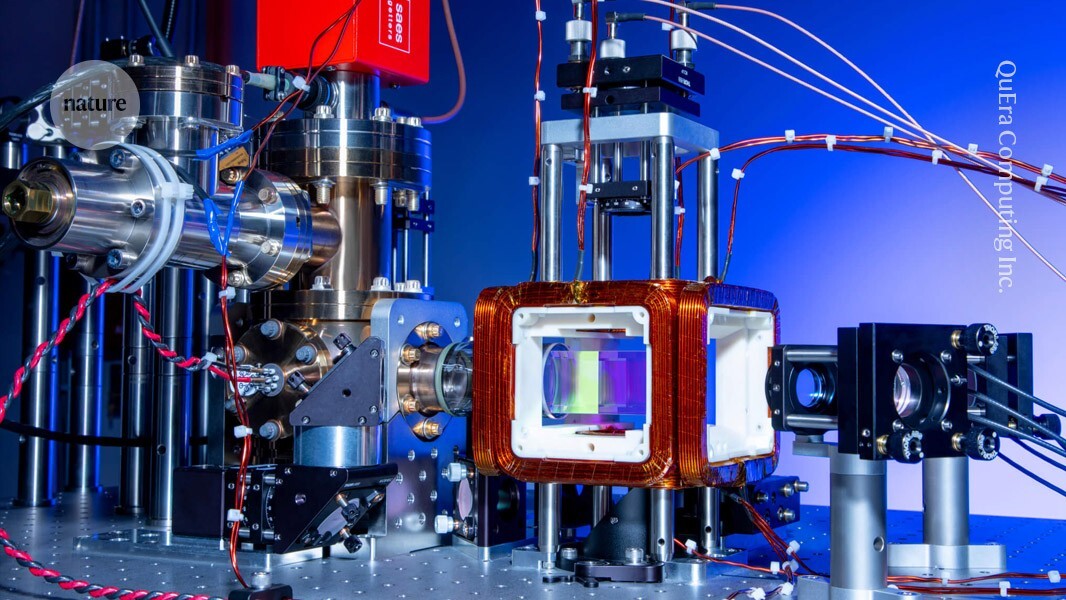
Subatomic particles such as quarks can pair up when linked by 'strings' of force fields ' and release energy when these strings are pulled to the point of breaking. Two teams of physicists have now used quantum computers to mimic this phenomenon and watch it unfold in real time. The results, described in two Nature papers on 4 June1,2, are the latest in a series of breakthroughs towards using quantum computers for simulations that are beyond the ability of any ordinary computers. 'String breaking is a very important process that is not yet fully understood from first principles,' says Christian Bauer, a physicist at the Lawrence Berkeley National Laboratory (LBNL) in California. Physicists can calculate the final results of particle collisions that form or break strings using classical computers, but cannot fully simulate what happens in between. The success of the quantum simulations is 'incredibly encouraging', Bauer says. Each experiment was conducted by an international collaboration involving academic researchers and corporate teams ' one at QuEra, a start-up company in Cambridge, Massachusetts1, and the other at the Google Quantum AI laboratories in Santa Barbara, California2....
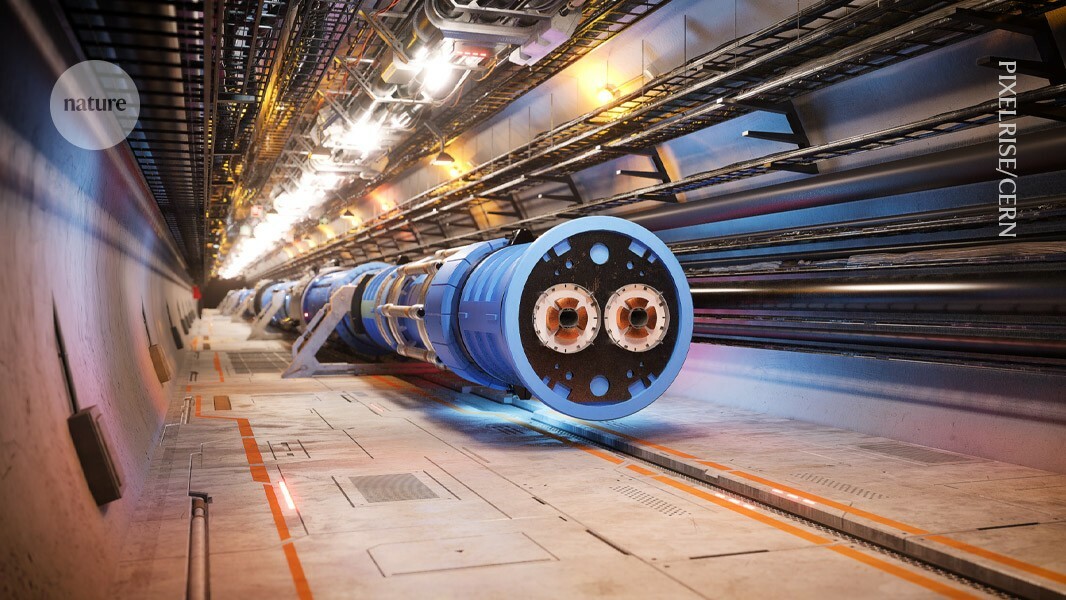
CERN, the European particle-physics laboratory outside Geneva, Switzerland, has embarked on a detailed feasibility study for the first stage of its Future Circular Collider (FCC). This stage, known as FCC-ee, would involve a machine to smash electrons together with antielectrons, and could cost some 15 billion Swiss francs (US$17 billion) by the time it is completed in the mid-2040s. The initial phase of that study, focusing on the technical aspects, had a positive outcome, CERN said in February. But Germany, which already contributes '267 million (US$290 million) annually to CERN ' some 20% of the lab's budget ' cannot afford to spend more, said Eckart Lilienthal of the country's Federal Ministry of Education and Research (BMBF) on 23 May, at a workshop for particle physicists in Bonn, Germany. The preliminary cost estimates for the FCC-ee 'are subject to a large number of uncertainties, the effects of which are still largely unknown', a BMBF spokesperson told Nature. 'The financing plan is extremely vague and requires a high level of commitment from external partners, which is neither assured nor even in prospect at the present time. Given these conditions, Germany cannot support funding of the project at this point.'...
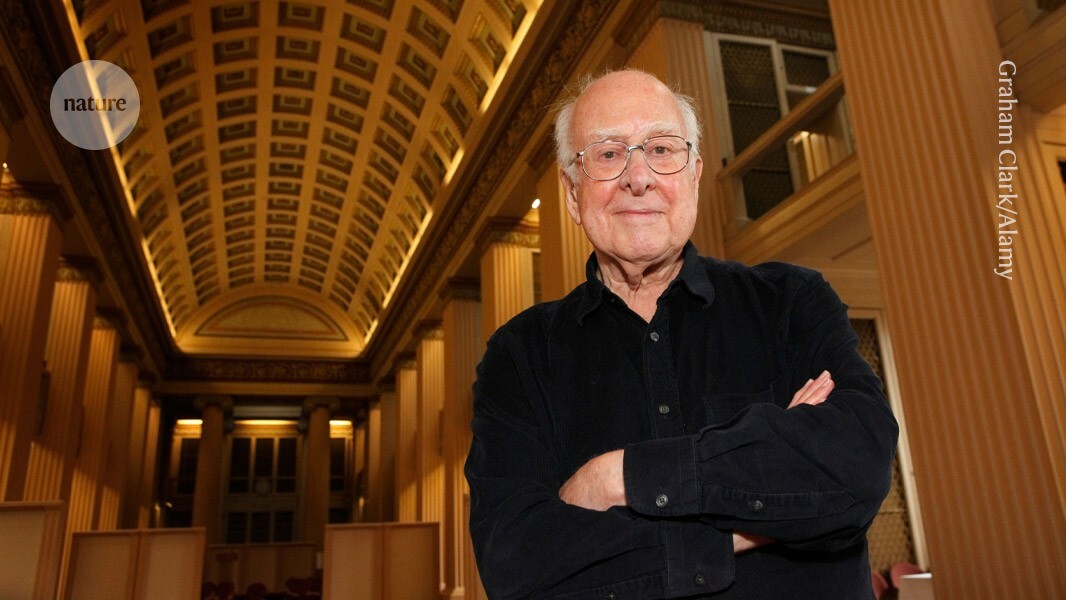
It was 60 years ago when Higgs first suggested how an elementary particle of unusual properties could pervade the universe in the form of an invisible field, giving other elementary particles their masses. Several other physicists independently thought of this mechanism around the same time, including Francois Englert, now at the Free University of Brussels. The particle was a crucial element of the theoretical edifice that physicists were building in those years,which later became known as the standard model of particles and fields. Two separate experiments at the Large Hadron Collider (LHC) near Geneva, Switzerland ' ATLAS and the CMS ' confirmed Higgs' predictions when they announced the discovery of the Higgs boson half a century later. It was the last missing component of the standard model, and Higgs and Englert shared a Nobel Prize in 2013 for predicting its existence. Physicists at the LHC continue to learn about the properties of the Higgs boson, but some researchers say that only a dedicated collider that can produce the particle in copious amounts ' dubbed a 'Higgs factory' ' will enable them to gain a profound understanding of its role....

Conditions at the lab were called into question in 2021, when Fermilab failed an annual assessment by its overseer, the US Department of Energy (DoE). It received a B grade overall ' a B+ was required to pass ' and earned a C for its handling of the troubled multibillion-dollar Deep Underground Neutrino Experiment (DUNE), the nation's flagship particle-physics project. Last year, the DoE took the unusual step of opening the bidding on the contract to run Fermilab, which since 2007 has been operated by the Fermi Research Alliance (FRA) ' a partnership between the University of Chicago in Illinois and the Universities Research Association, a consortium of 90 mostly-US-based universities. A University of Chicago spokesperson emphasized the university's 'deep and longstanding commitment' to Fermilab, and declined to comment further, but Nature has confirmed that the FRA is reapplying to manage the lab. The FRA is not the only contender. Associated Universities, Inc. (AUI), which runs the Green Bank Observatory in West Virginia, has confirmed that it is competing for the contract. 'AUI excels in making scientific and technological breakthroughs possible by delivering on large science projects on-time and on-budget,' AUI chief executive Adam Cohen told Nature. 'We are very interested in bringing our experience to the challenges we understand exist at Fermi.'...