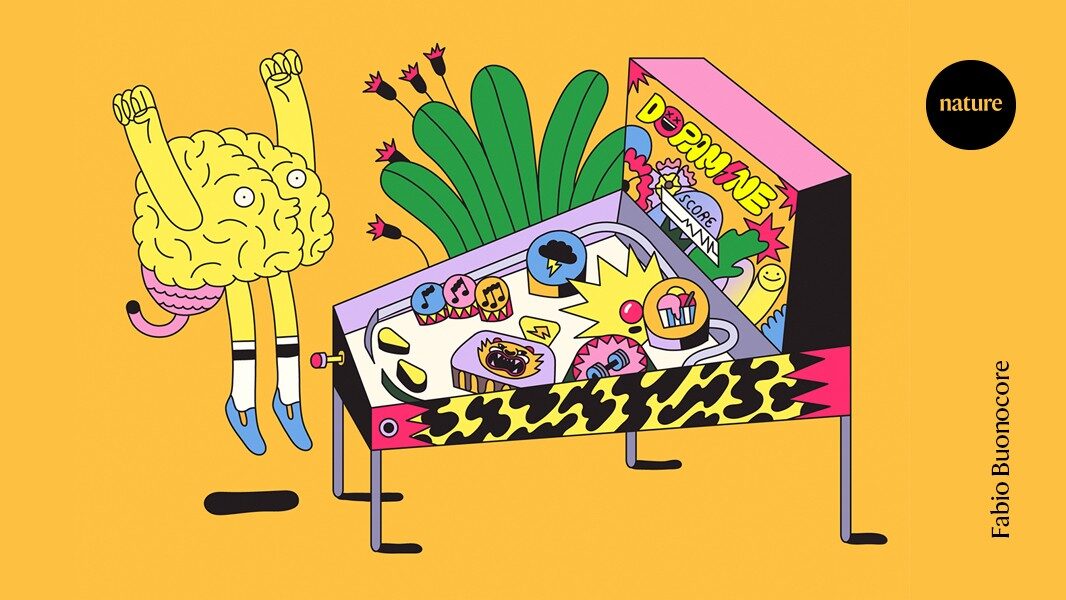
When neuroscientists gather in the Spanish city of Seville in May for the annual Dopamine Society meeting, one discussion could be unusually lively. Session 31 will feature a debate between researchers who fundamentally disagree about the role dopamine has in the brain. Dopamine is one of the most extensively studied neurotransmitters, chemicals that convey signals from cell to cell. It's the one with the highest profile outside neuroscience: often known as the 'pleasure chemical', it's depicted as the hit of reward that people get from recreational drugs or scrolling through social media. That's a gross simplification of what dopamine does; on that, researchers agree. But beyond that, where once there was a simple model that explained how dopamine works in the brain, now there are challenges that seek to amend the theory ' or even to overturn it. This could have implications not only for basic neuroscience, but also for clinicians trying to explain and treat conditions such as attention deficit hyperactivity disorder (ADHD) and addiction. If the model is wrong or needs modification, then so might some of the assumptions about what drives these disorders and the best way to treat them....
In our rush to embrace AI tools and the processing speed they promise us, we may need to pause to reflect on what we're outsourcing'not just in terms of tasks, but in terms of thinking itself. The promise of cognitive offloading is undeniably appealing: Who wouldn't want to think less about the mundane' Yet this convenience may come at a cost. When we consistently offload our attention, we miss opportunities for deeper thought, and sacrifice our moments of insight, we risk dulling the very qualities that make us human....

Computational neuroscientist and singer/songwriter Kimaya (Kimy) Lecamwasam, who also plays electric bass and guitar, says music has been a core part of her life for as long as she can remember. She grew up in a musical family and played in bands all through high school. 'For most of my life, writing and playing music was the clearest way I had to express myself,' says Lecamwasam. 'I was a really shy and anxious kid, and I struggled with speaking up for myself. Over time, composing and performing music became central to both how I communicated and to how I managed my own mental health.' 'I got to see firsthand not only the ways that audiences reacted to music, but also how much value music had for musicians,' she says. 'That close connection between making music and feeling well is what first pushed me to ask why music has such a powerful hold on us, and eventually led me to study the science behind it.' Lecamwasam earned a bachelor's degree in 2021 from Wellesley College, where she studied neuroscience ' specifically in the Systems and Computational Neuroscience track ' and also music. During her first semester, she took a class in songwriting that she says made her more aware of the connections between music and emotions. While studying at Wellesley, she participated in the MIT Undergraduate Research Opportunities Program for three years. Working in the Department of Brain and Cognitive Sciences lab of Emery Brown, the Edward Hood Taplin Professor of Medical Engineering and Computational Neuroscience, she focused primarily on classifying consciousness in anesthetized patients and training brain-computer interface-enabled prosthetics using reinforcement learning....

For about the past two decades, scientists have been discovering more and more about the growing brain. This exploration of neurobiology has led to new types of trauma treatments, a deeper understanding of the nervous system and an appreciation of how environmental and genetic factors interact to shape a child's behavior. As the science has become increasingly actionable, more evidence-based strategies are spilling into parenting and educational programs. Research offers some useful guideposts for how parents and caregivers can change our adult ways to foster healthy child development. It turns out that many old-school parenting and educational approaches based on outdated behavioral models are not effective, nor are they best-practice, particularly for the most vulnerable children. I don't come to this view lightly. I'm a behavioral scientist and a professor of public health with degrees in mathematics and biostatistics. When my children were little, I read all the parenting books and applied a somewhat academic strategy to my job of parenting. I firmly endorsed conventional recommendations from authors and pediatricians: I dutifully sent my children to their rooms to think about their choices and dug in my heels to enforce consequences....