
The scales of a pine cone open in low humidity to scatter seeds, but close in damp conditions to protect seeds from moisture. An artificial material with the same behavior could be useful in applications like moisture-responsive shingles for passive cooling. Their framework captures how mechanisms across length scales in a natural system, like the cells, fibers, and tissues inside a pine cone, work together to achieve unique properties. It then formally translates that behavior in an engineered system. The framework organizes biological behavior into building blocks that can be used to design synthetic structures that can be mathematically validated to perform the same way, and fabricated using a 3D printer. 'What really excites me about this work is going beyond bio-inspiration to what we could call 'bio-derivation,' where we move past observing a unique behavior to capturing the relationships and mechanisms that are actually producing that behavior, and then finding a systematic way to translate them into an engineered system,' says Lee Marom....
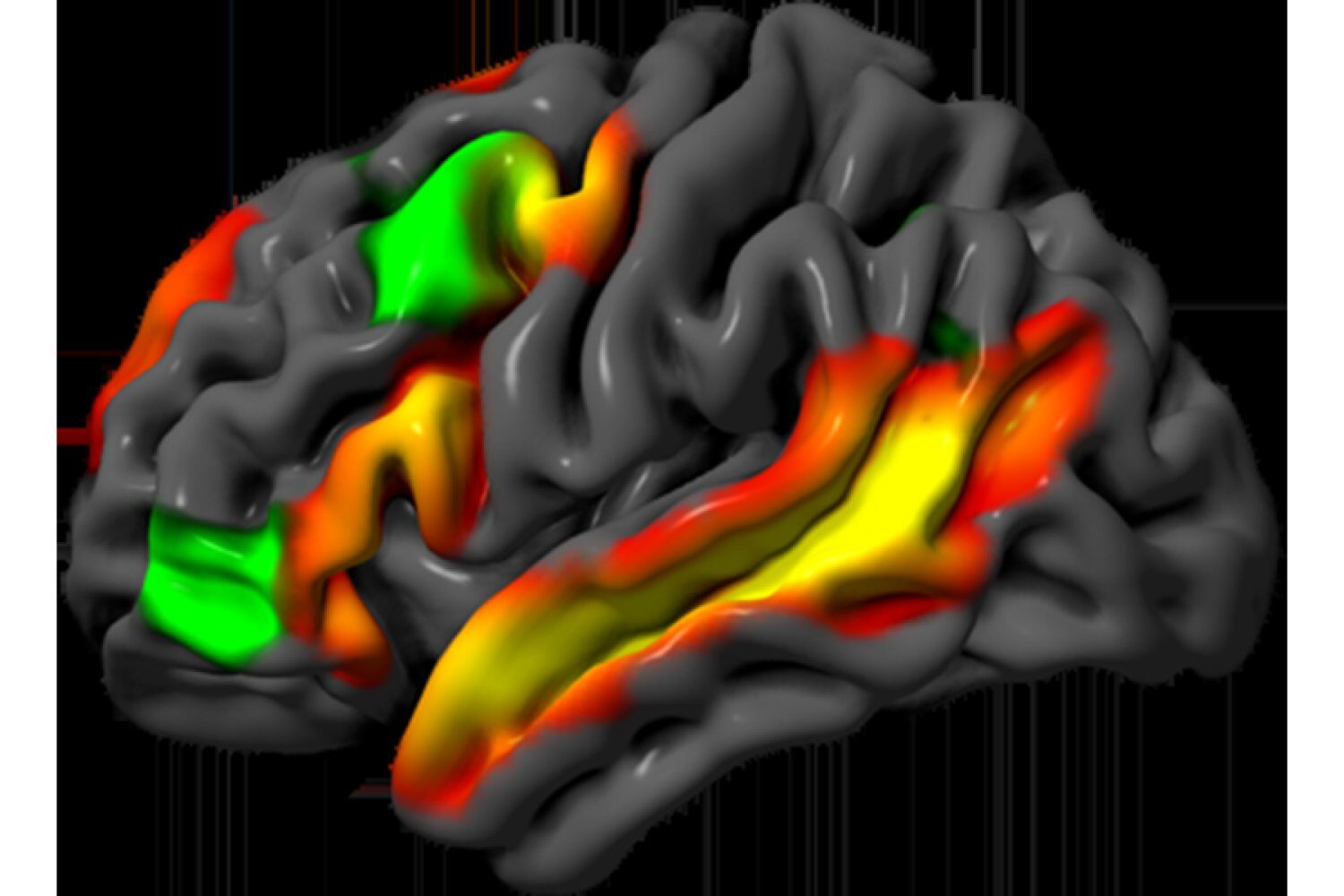
In research published this week in the journal PNAS, researchers led by MIT associate professor of brain and cognitive sciences Evelina Fedorenko have shown that people can perform well on tasks that require logical reasoning even if their language abilities are severely impaired. What's more, brain imaging shows that language-processing parts of the brain are not called on for logical reasoning. Philosophers, linguists, and cognitive scientists have debated the relationship between language and thought for thousands of years, with many arguing that we use language to think. There are good reasons to suspect a close relationship between logic and language, acknowledges Hope Kean, a postdoc and former K. Lisa Yang Integrative Computational Neuroscience (ICoN) Center graduate fellow in Fedorenko's lab. 'Abstract thinking has properties that look a lot like language,' Kean says, pointing to structural similarities. 'You can decompose a thought into subcomponents, like little atoms of logical propositions, and you can combine them in a hierarchical manner to make more complex structured rules, very akin to language.'...

American dress codes seem to grow more lenient by the day. Jeans, sneakers, and T-shirts are ubiquitous among so-called white-collar workers. The taboo against shorts in professional settings, however, has endured. Here in Washington, D.C., the hot, humid summer air feels like a dog's breath in your face. But legions of male office workers are expected to keep their legs bundled up, even as their female co-workers shiver in the air-conditioned chill. When I exposed my knees at the office recently'I'd biked to work and hadn't had a chance to change, I swear'I triggered a lively discussion on Slack. I was made to understand that shorts were for children. Why does the no-shorts rule cling so stubbornly to life, like trousers stuck to sweaty thighs in June' No one has a satisfying answer. It might be the most illogical fashion convention still standing. That means its days are probably numbered, and the glorious era of leg liberation is nigh. There was a time when shorts really were for little boys. In the late-Victorian period, British schools adopted short pants for the youngest male students. This practice eventually spilled over into non-Commonwealth countries. Steve Knorsch, the U.S. managing director for the men's clothier Cad & the Dandy, told me that at his all-boys school in 1970s Belgium, he wore shorts as part of his uniform'along with knee-length socks, a blazer, and a tie'until he was old enough for pants....

Defense, energy, robotics and government have historically been classic no-go areas for VC investment. These 'hard' industries have slow procurement cycles, tight regulatory oversight and high-friction customer migration in common. Legacy software vendors serving them have benefited from a barrier of complexity to innovate slowly without facing the risk of customer churn. This made the victims of this year's AI anxiety-driven sell-off all the more dramatic. Software juggernauts serving heavy industries ' IBM, SAP, ServiceNow, Schneider Electric ' have gone from safe bets to being the subject of investor scrutiny. While headlines have attributed that sell-off to quick-fire Anthropic launches of tools for vertical industries, there's more at play. The macro trend is a newfound founder enthusiasm to build AI-native entrants in legacy industries, and the backing they're enjoying from VCs that can see the once-in-a-generation opportunity to disrupt entire industries. Be it the U.S. or across Europe, policymakers are prioritizing investment in grid upgrades, transportation networks and public sector infrastructure, while also re-examining procurement and compliance systems that have slowed the adoption of emerging technologies that could bring said industrial resilience about quicker....