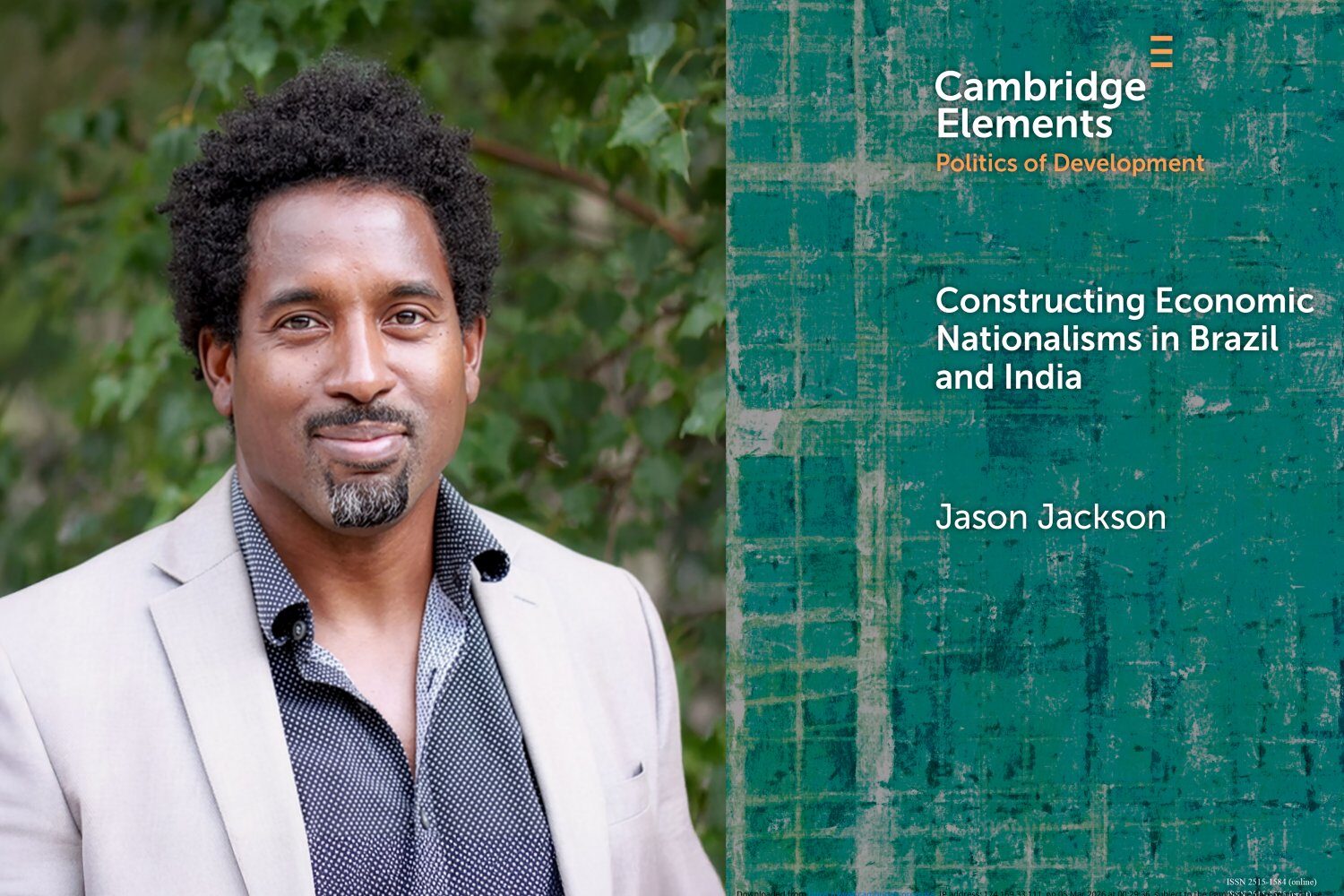
The end of World War II marked a turning point for global empires; weakened by years of conflict, European nations could no longer hold onto their colonies. A wave of independence followed. This shift was fueled by local anti-colonial activists, the heavy economic toll of the war, and the strategic interests of the new global superpowers, the United States and the Soviet Union. Yet these transformations also raised an important question: How would these developing nations approach economic independence' In his latest book, 'Constructing Economic Nationalisms in Brazil and India' (Cambridge University Press, 2026), MIT Department of Urban Studies and Planning (DUSP) Associate Professor Jason Jackson tracks how two of these emerging nations developed different brands of economic nationalism from the late 1800s through the early post-World War II era. The timing of the book is prescient. The rise of globalization in the 1980s, 1990s, and 2000s led many observers to declare nationalism a relic of the past. Yet economic nationalism has returned with a vengeance over the past few years, making clear the importance of understanding this phenomenon in its historical and contemporary forms....

'David is a world-class labor economist,' says Agustin Rayo, the Kenan Sahin Dean of the School of Humanities, Arts, and Social Sciences. 'He is also an individual of wisdom and insight. I look forward to welcoming him to the school's leadership team.' Autor's scholarship explores the labor-market impacts of technological change and globalization on job polarization, skill demands, earnings levels and inequality, and electoral outcomes. He serves as faculty co-director of the James M. and Cathleen D. Stone Center on Inequality and Shaping the Future of Work. 'I've been at MIT since 1999, and I owe my career to the Institute, the department, and colleagues who are as kind as they are accomplished,' Autor says. 'Stepping into this role is a chance to contribute to a place that has shaped me at every stage.' Autor serves as co-director of the National Bureau of Economic Research (NBER) Labor Studies Program. He earned a BA in psychology from Tufts University in 1989 and a PhD in public policy from Harvard University's Kennedy School of Government in 1999....

A decade or so ago, pairing Everlane kick-crop jeans with the brand's almond-toe Modern Loafer and a crewneck sweater was a quintessential Millennial city-girl uniform: minimalist, boring, and, most important, vaguely ethical. The San Francisco'based fashion start-up was founded in the early 2010s on the premise of 'radical transparency.' It told consumers about the factory where their shirt was made and the cost to produce it, down to the labor and markup, which it said was a fraction of the markup of other retailers. It was a brand built on the belief that globalization could work for everyone, and that anybody could shop with their values. But now Everlane is in bad shape. It's $90 million in debt, behind on rent, and facing eviction at its headquarters. This week, Puck reported that the company has found a buyer that seems antithetical to the values it once said it held: Shein, the online fast-fashion behemoth synonymous with overconsumption and workplace abuses such as child labor. Shein, in response to allegations of poor conditions over the years, has made efforts to address critics, such as investing in carbon-reducing initiatives and ending orders at factories that have known problems. Still, the era of sustainable fashion that Everlane represents seems to be fading'as does the concept that ethical consumerism alone can eliminate the clothing industry's worst practices. (Everlane declined to comment on reports of the sale, and Shein did not immediately respond to an interview request.)...

Global geopolitical turbulence signals not the end of globalization but its structural reconfiguration. Businesses are confronting the weaponization of supply chains, the segmentation of digital ecosystems, and an increase in industrial policy competition. The next phase of global competition will favor companies that rethink organization, supply chains, and governance architectures to remain globally connected yet geopolitically separable to retain market access across competing blocks. The international order is undergoing structural transformation. War in the Middle East, the prolonged conflict in Ukraine, and major shifts in U.S. trade and foreign policy that have altered the country's traditional alliances are manifestations of a broader reconfiguration of power. Tariffs, export controls, sanctions, and the vulnerability of strategic choke points as diverse as maritime straits and semiconductor ecosystems are exposing the fragility of globally optimized supply chains and production networks....