MIT associate professor of physics Riccardo Comin has been selected as 2025 Experimental Physics Investigator by the Gordon and Betty Moore Foundation. Two MIT physics alumni ' Gyu-Boong Jo PhD '10 of Rice University, and Ben Jones PhD '15 of the University of Texas at Arlington ' were also among this year's cohort of 22 honorees. The prestigious Experimental Physics Investigators (EPI) Initiative recognizes mid-career scientists advancing the frontiers of experimental physics. Each award provides $1.3 million over five years to accelerate breakthroughs and strengthen the experimental physics community. At MIT, Comin investigates magnetoelectric multiferroics by engineering interfaces between two-dimensional materials and three-dimensional oxide thin films. His research aims to overcome long-standing limitations in spin-charge coupling by moving beyond epitaxial constraints, enabling new interfacial phases and coupling mechanisms. In these systems, Comin's team explores the coexistence and proximity of magnetic and ferroelectric order, with a focus on achieving strong magnetoelectric coupling. This approach opens new pathways for designing tunable multiferroic systems unconstrained by traditional synthesis methods....
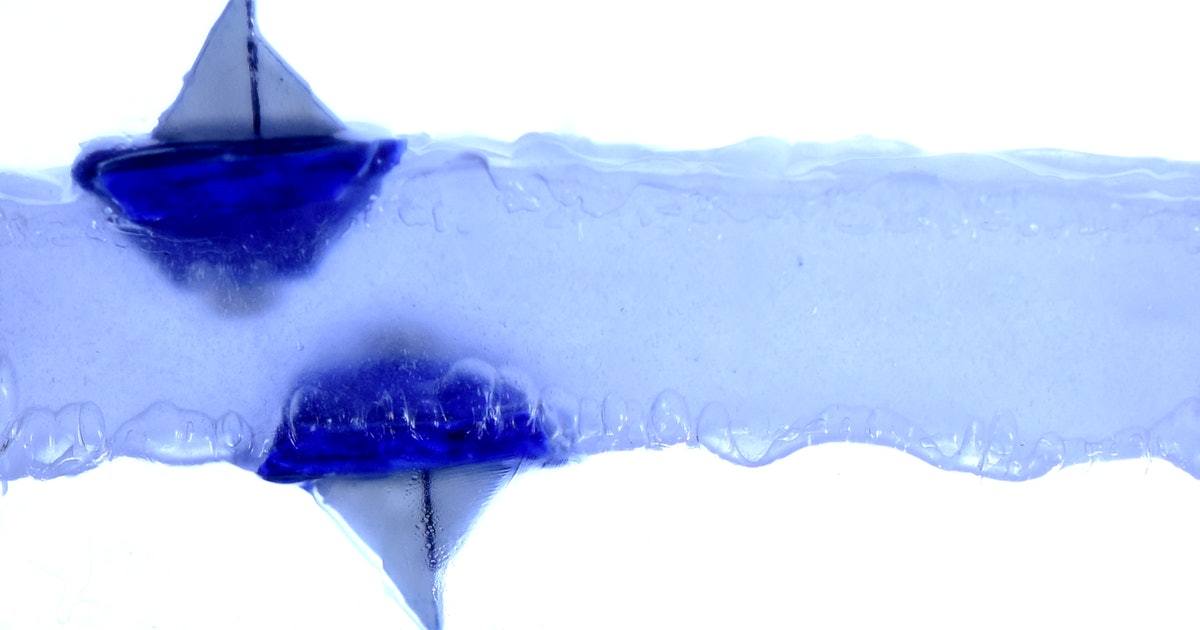
It was over 2,000 years ago that Archimedes allegedly ran naked and dripping wet through the streets of Syracuse, Italy exclaiming "Eureka!" in exaltation over the discovery of a fundamental physical phenomena: buoyancy. This push and pull between gravity and the "buoyant" upward forces of a liquid are what keeps ships at sea (and, in the case of Archimedes, helped uncover a fraudulent royal crown).But, while this discovery may be ancient, a team of French physicists has now discovered a new kind of buoyancy that they call "anti-gravity." In both theoretical and experimental trials, the researchers found that objects, such as small toy boats, could float on the opposite side of levitated fluids instead of falling down due to gravity.Scientists have long known that vibrating a medium, like a body of water, at just the right frequency can cause strange physical properties to arise. Famously, Russian Nobel laureate and physicist, Pyotr Kapitza, discovered in 1951 that applying vibrations to a pendulum could create a secondary stable equilibrium point. While a normal pendulum swings down from left to right with gravity, Kapitiza's vibrating pendulum could do the same, but pointed upwards, seemingly against the force of gravity....