
The White House's AI Action Plan, released in July, mentions 'health care' only three times. But it is one of the most consequential health policies of the second Trump administration. Its sweeping ambitions for AI'rolling back safeguards, fast-tracking 'private-sector-led innovation,' and banning 'ideological dogmas such as DEI''will have long-term consequences for how medicine is practiced, how public health is governed, and who gets left behind. Already, the Trump administration has purged data from government websites, slashed funding for research on marginalized communities, and pressured government researchers to restrict or retract work that contradicts political ideology. These actions aren't just symbolic'they shape what gets measured, who gets studied, and which findings get published. Now, those same constraints are moving into the development of AI itself. Under the administration's policies, developers have a clear incentive to make design choices or pick data sets that won't provoke political scrutiny....

A few years ago, a student in my history of public health course asked why her mother couldn't afford insulin without insurance, despite having a full-time job. I told her what I've come to believe: The U.S. health care system was deliberately built this way. People often hear that health care in America is dysfunctional ' too expensive, too complex and too inequitable. But dysfunction implies failure. What if the real problem is that the system is functioning exactly as it was designed to' Understanding this legacy is key to explaining not only why reform has failed repeatedly, but why change remains so difficult. I am a historian of public health with experience researching oral health access and health care disparities in the Deep South. My work focuses on how historical policy choices continue to shape the systems we rely on today. By tracing the roots of today's system and all its problems, it's easier to understand why American health care looks the way it does and what it will take to reform it into a system that provides high-quality, affordable care for all. Only by confronting how profit, politics and prejudice have shaped the current system can Americans imagine and demand something different....

The A$335 billion ($223 billion) fund has started the new financial year 3% overweight in stocks. AustralianSuper has moved money from its fixed interest and cash portfolios to expand its global and domestic equities allocation to about 57.5% of its portfolio, a position it expects to maintain or 'possibly' increase, Chief Investment Officer Mark Delaney said in an interview. Delaney ' like other large investors ' has benefited from exposure to the 'Magnificent Seven' mega caps. He likened the current tech boom to other periods of innovation such as the introduction of computing, the internet and mobile phones, that would run for 5 to 10 years in three phases. He also anticipates that the US Federal Reserve will cut interest rates, giving stocks additional support. AustralianSuper's balanced option, where 90% of members have their retirement savings invested, returned 8.5% for the financial year. The high growth option delivered 10.2%. Rival Australian Retirement Trust, the nation's second-largest fund with A$285 billion, returned 11.3% for its high growth option. The broader industry has returned 8.8% for the financial year, according to research house SuperRatings....
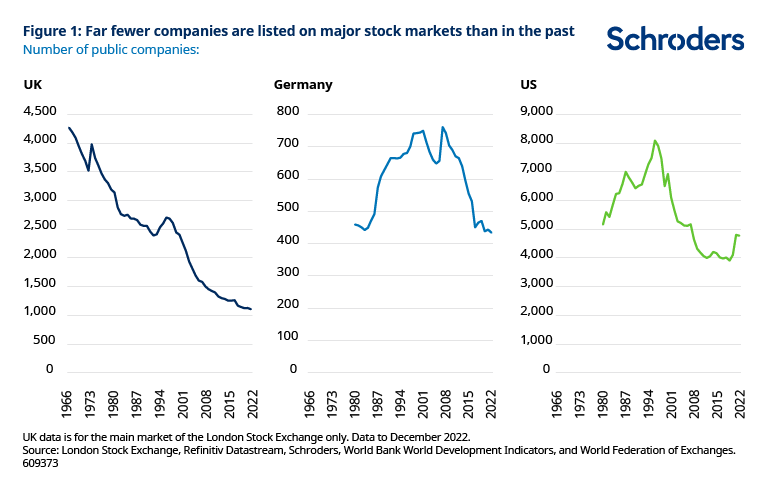
Anyone who is fortunate enough to have a bit of spare cash can consult the financial pages, pick specific companies to invest in and buy shares in certain companies with the hope that their value will increase. It's an enticing way to generate returns that outpace inflation. But that dynamic has changed in the past few decades, with fewer companies choosing to list their shares on stock exchanges, and make them available to a wide audience. This shift means savers have fewer options to choose from, and risk losing out on opportunities to invest in some of the world's most innovative and fastest growing companies. There's been a net reduction of $120 billion in public equities this year, according to JPMorgan analysts, a figure that dwarfs last year's $40bn decrease and marks the third consecutive year of decline. JPMorgan's data suggests persistent uncertainty among companies worldwide. Share buybacks ' when companies repurchase their own shares from shareholders in the market ' have stayed stable, while share offerings have fallen, meaning there are fewer shares available overall....


