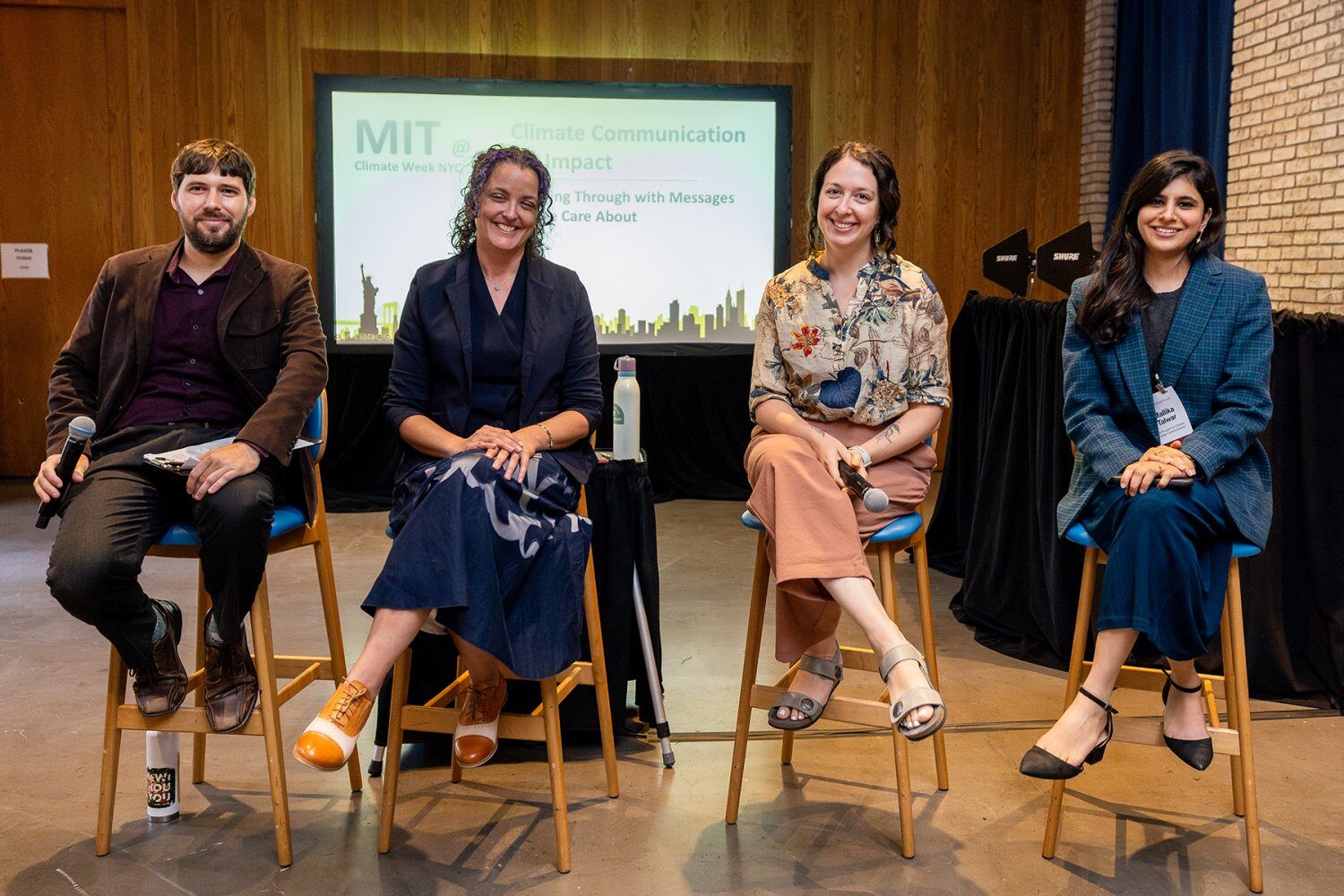
Each year, Climate Week NYC brings together more than 100,000 people in more than 1,000 events across the city to discuss climate challenges, explore solutions, and spur action. Participants come from industry, academia, philanthropy, nonprofits, government, and finance and venture capital. And this year, the mix included a strong, cross-campus presence from MIT. The MIT community could be seen multiple days during Climate Week, with appearances by Evelyn Wang, vice president for energy and climate, at the official opening ceremony discussing artificial intelligence and the climate equation; an event co-hosted by MIT and the Bezos Earth Fund on climate innovation; and 14 sessions organized by the MIT Climate Project and eight MIT departments, labs, centers, and initiatives ' including the Abdul Latif Jameel Water and Food Systems Lab (J-WAFS), the MIT Sloan Sustainability Initiative, the Center for Transportation and Logistics (CTL), MIT Lincoln Laboratory, MIT Open Learning, the MIT Initiative for New Manufacturing (INM), the MIT Climate Policy Center, and the Priscilla King Gray (PKG) Center for Social Impact....
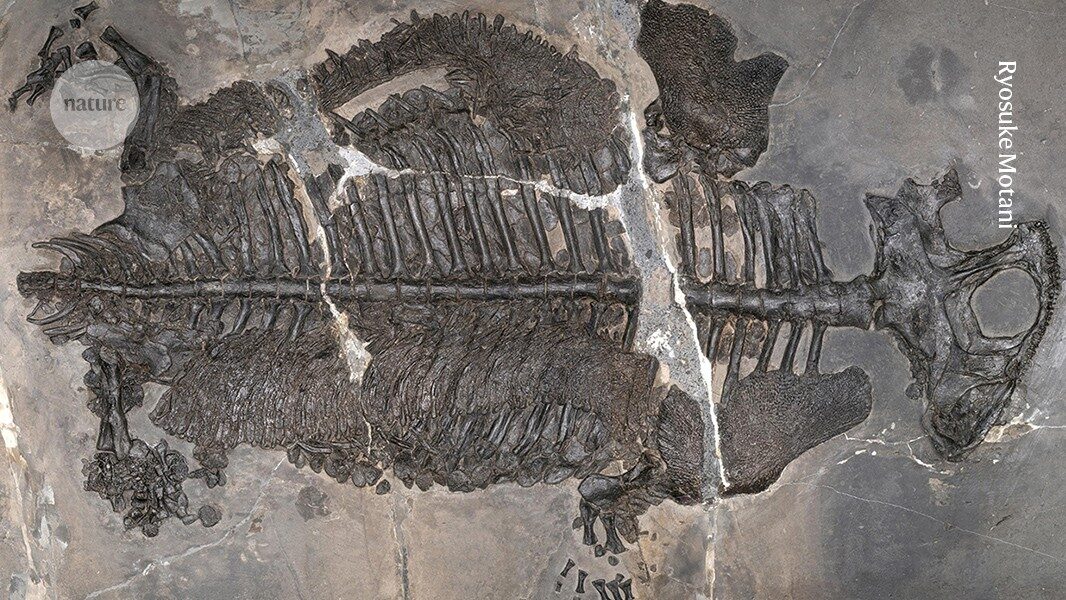
Two fossils of a type of primitive amphibian from a group called temnospondyls were found in what is now Guizhou province in China ' which would have been a salty sea during the Late Triassic period. The researchers have provisionally named the species Gerrothorax maritimus. The 74-centimetre-long creatures had flattened bodies and were almost completely covered in body armour. There are more than 8,000 modern amphibian species, but none of them lives exclusively in a marine environment. 'This is potentially a revolutionary discovery,' says Steve Brusatte, a palaeontologist and evolutionary biologist at the University of Edinburgh, UK. 'If this Triassic amphibian, Gerrothorax, really was fully marine, then it is a game-changer.' Amphibians have varying levels of salt tolerance, says Ryosuke Motani, a palaeobiologist at the University of California, Davis, and a co-author of the study. But even salt-tolerant animals need to recover from excess salt in one way or another, he explains. 'In most cases, they do it by drinking fresh water.'...
In this edition of the HBR Executive Agenda, editor at large Adi Ignatius speaks with Eurasia Group's Ian Bremmer about why he believes that we may actually be on the brink of a more stable business environment. He cites three big-picture issues'the U.S. midterm election, U.S.-China relations, and trade'that could generate more predictability and calm. But, Bremmer notes, AI could be the big destabilizing force affecting all of the above...

TLDR: AI environments are becoming a core ingredient of model capability: executable worlds that generate trajectories and feedback, not just exams. This essay traces their path from Atari, OpenAI Gym, and AlphaZero through MuJoCo to the RLVR-driven post-training behind Tulu 3 and DeepSeek-R1, then surveys the new generation of agent environments, including SWE-Gym, WebArena, OSWorld, TheAgentCompany, Tau2-bench, and AgentMercury. It then lays out what makes a good environment: rewards that track the real outcome and resist hacking, causal fidelity, affordable and repeatable practice, structured difficulty, and improvement that transfers outside the training world. The frontier, the essay argues, is the supply of varied, consequential practice with dependable feedback. Imagine hiring an engineer who has read every programming book but has never run a program. They can explain databases, discuss distributed systems, and produce an impressively confident architecture diagram. Then you ask them to fix a failing deployment. Suddenly, the difference between describing work and performing it becomes rather expensive....