
Innovation, reflection, and celebration will blend at the Boston Symphony Orchestra this week, where MIT composer Tod Machover's inventive new work 'already and not yet' will see its world premiere on Thursday. Machover, one of the world's most prominent composers, has incorporated multiple ongoing interests into the new symphony, including AI tools interacting with the musicians, and a piece that is structured as a meditation on the crisis and promise of democracy. 'An orchestra is an interesting ensemble to use for thinking about how different groups of people can relate to each other,' says Machover, who is the Muriel R. Cooper Professor of Music and Media and faculty director at the MIT Media Lab, where he also serves as director of the Opera of the Future group. He adds: 'John Cage used to say one way to think of a piece of music is that it should be like the society you'd like to live in. I was always inspired by this idea, and thought of the orchestra ' and constructed this new piece ' in this way.'...
The internet is having a bad day, from a cybersecurity perspective. Government websites around the world went offline, Reuters reported, after AI discovered critical security vulnerabilities that impacted the programming language PHP. The issues were severe enough that the U.S. National Security Agency (NSA) advised organizations using PHP on their systems to either immediately update or take their systems offline until they could. But the PHP update wasn't the only headache cybersecurity folks were facing on Wednesday. Node.js, the open-source JavaScript runtime environment, also dropped a security surprise of its own when it shared that four high-severity vulnerabilities were just patched in its latest release. One allowed remote code execution, and two others would have permitted a TLS validation bypass, potentially allowing attackers to bypass checks intended to verify a server's identity. In addition, LiteLLM, a popular open source proxy for routing requests to multiple LLM providers, was compromised by an attacker who injected malicious code, the company shared in a post on X on Wednesday afternoon. The malicious artifacts were published to PyPI (Python Package Index), Docker Hub, and GHCR (GitHub Container Registry), the post noted....
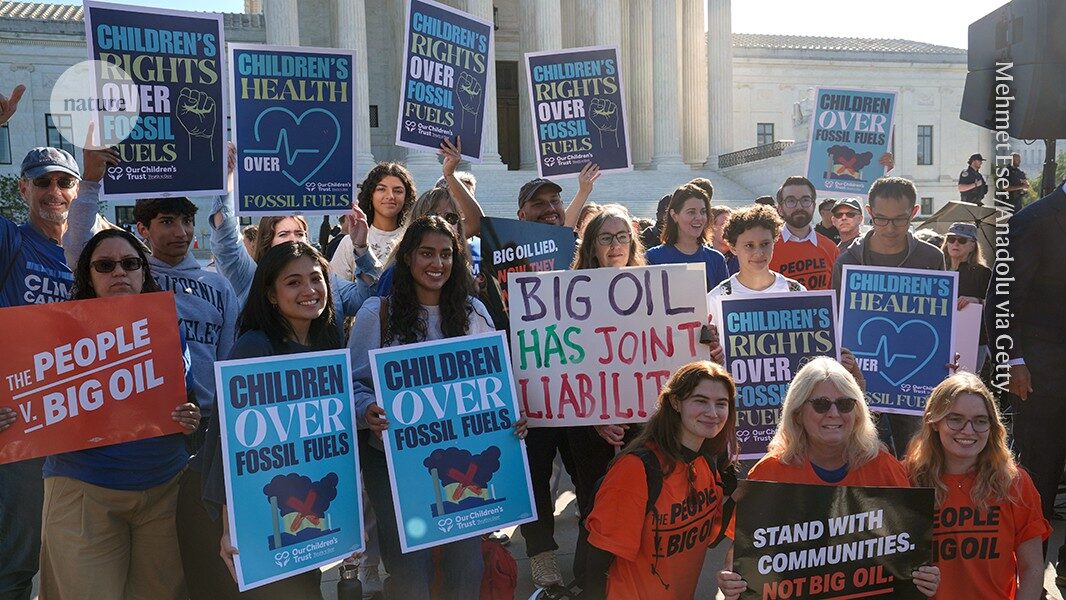
Protestors demonstrate outside the US Supreme Court on 5 October, as justices hear a case whose outcome could determine whether fossil-fuel companies can be held responsible for global warming.Credit: Mehmet Eser/Anadolu via Getty Last month, a climate scientist working in the University of California system received an unsettling message from her institution. University officials asked her to submit all correspondence related to a study she had published linking emissions from fossil fuels to environmental harms caused by climate change. The university had received a public-records request from a law firm representing the Patriots Foundation in Des Moines, Iowa, which describes itself on its website as a government watchdog. The requests seem to be part of an expanding effort by groups with ties to the energy industry to discredit findings in the burgeoning field of climate attribution science, which estimates the extent to which extreme weather events, such as floods and heatwaves, are due to climate change. The demands come at a time when attribution science's role in lawsuits against major industrial emitters is growing....
The investigation is focused on the universities' use of J-1 visas, the main visa used by international postdoctoral researchers. The probe's purpose is to reduce 'visa fraud', according to vice-president JD Vance. 'They're using these visas way too much,' Vance said when announcing the investigation on 8 October. 'They're using them to undercut the wages of American grad students and American researchers, and it simply has to stop.' Critics say that the rationale for the investigation is flawed, that international postdocs play a crucial part in US laboratories and that the announcement is deepening the sense of unease felt by international scientists. 'For folks who are not US citizens, it's pretty dire. It really makes people nervous,' says Theresa Desrochers, a neuroscientist at Brown University in Providence, Rhode Island, whose lab has hosted a number of visa-holding postdocs over the years. 'It just contributes to an overall mood of 'you're not wanted here'.' The institutions under investigation are Harvard, Stanford, Arizona State, Yale and Brown universities; the Massachusetts Institute of Technology; the California Institute of Technology; the University of California, Davis; and the University of Pittsburgh....


