Regardless of the answer, artificial intelligence titan Anthropic has launched a biology 'wet lab' where human scientists and AI agents will work together to design and conduct experiments. This week, the company announced one of the team's first finds: a peculiar pattern of DNA in the genomes of several giant viruses. Similar patterns are found in DNA encoding the CRISPR immune systems of some microbes. Scientists have developed those microbial systems into powerful genome-editing tools. But researchers at Anthropic, which is headquartered in San Francisco, California, have not yet determined what the newfound viral sequences do, and thus whether their function is similar to that of the parallel sequences in microbial CRISPR systems. Even so, the finding, posted online on the alphaXiv platform, offers a first glimpse into Anthropic's new life sciences research group and its associated lab, as well as how its AI tools could be used to mine petabytes of genomic data in search of novel molecular tools. The company announced the new lab and released the preprint on 23 September. The preprint has not yet been peer reviewed....
The DNA-shredding approach, reported in two papers in Nature1,2, could provide a way for researchers to kill cancer cells that express 'undruggable' mutant proteins that have been difficult to target using conventional medicines. 'It's a molecular kill switch that recognizes a particular RNA,' says Yang Liu, a molecular biologist at the University of Utah School of Medicine in Salt Lake City, and an author of one of the papers. 'This is basically a programmable chemotherapy.' A therapy that uses this approach to target head and neck cancers caused by human papillomavirus (HPV) is already in early development at Akribion Therapeutics, a biotechnology company in Zwingenberg, Germany. The goal is to produce the first clinical-trial data by 2030, says company co-founder Paul Scholz, who is head of research and development at Akribion and a co-author of one of the papers. CRISPR systems occur naturally in bacteria and other microorganisms, in which they act as a protective immune mechanism. Some CRISPR systems use RNAs that direct CRISPR-associated (Cas) enzymes to target stretches of DNA in viruses and other invaders. The Cas enzyme then cuts the DNA, destroying the interloper. For more than a decade, researchers have harnessed and modified such systems to edit genomes, creating their own guide RNAs to direct the Cas enzymes to a desired site for editing....
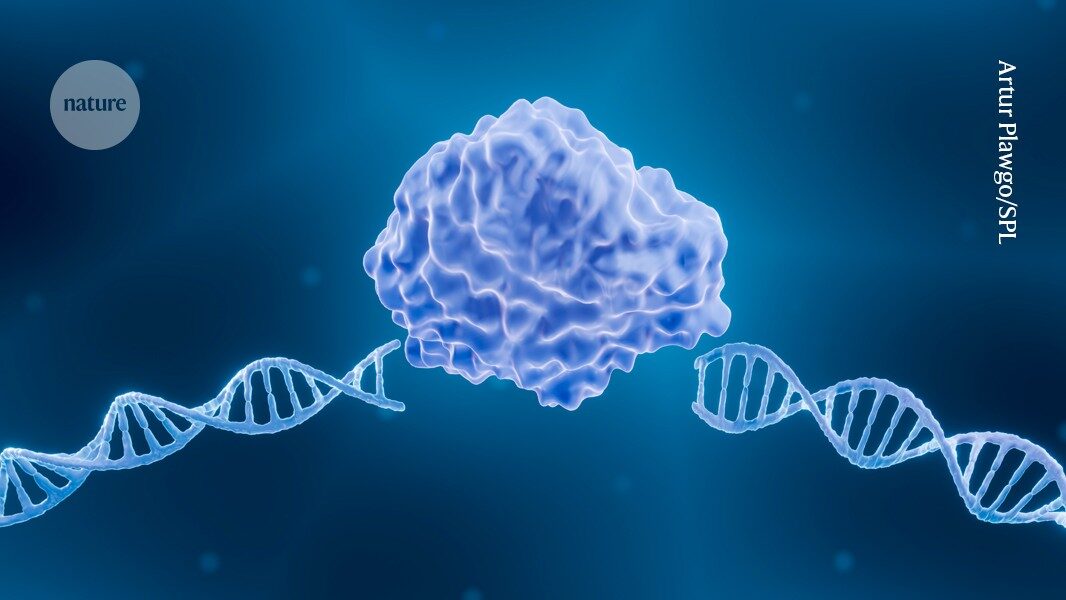
Scientists have harnessed artificial-intelligence models to create synthetic CRISPR proteins that edit the genome more efficiently than their naturally occurring counterparts. Such synthetic CRISPR systems could one day power discoveries in fields from medicine to agriculture. 'Much like CRISPR democratized the ability to edit DNA at will, AI-based protein design promises to allow anyone to create totally novel properties in the protein space,' says Soeren Lienkamp, a molecular biologist at the University of Zurich in Switzerland who was not involved in the research. He adds that the paper 'marries two transformative fields': AI-guided design and enzymes called RNA-guided nucleases, which can cut DNA and RNA strands. These nucleases form the backbone of the gene-editing system known as CRISPR, which uses a 'guide RNA' to direct the nuclease to a target DNA sequence. The nuclease then acts like molecular scissors and snips out the targeted material, enabling scientists to edit, delete or add genetic information. CRISPR systems are based on the machinery that bacteria use to defend themselves against viruses. The most common CRISPR nucleases, such as Cas9 and Cas12, are co-opted from bacteria....

In late 2021, Amber Salzman interviewed for a job that she had no intention of taking. A relatively new start-up company, called Epicrispr Biotechnologies, was looking for a chief executive, and it was keen on vetting Salzman ' who had decades of experience in the pharmaceutical industry ' for the role. She had said yes to the meeting only as a favour to a recruiter, who had helped her to fill a key position at another company she had worked with. Joining the start-up wasn't something she was enthusiastic about. Halfway through the meeting, she changed her mind. Salzman had watched as Stanley Qi, the founder of Epicrispr, drew diagrams on a whiteboard explaining that the company wanted to make a genetic therapy ' not by editing the code itself, but by changing the chemical markers attached to DNA, which can switch genes on or off. Then Salzman asked another team member: ''What disease are we going after'' And she said, 'FSHD'.' Salzman knew the condition all too well. FSHD, short for facioscapulohumeral muscular dystrophy, is an inherited disorder in which muscle problems first begin in the face and upper body and can spread to other parts, sometimes requiring wheelchair use. Salzman's husband of more than 35 years had several cousins and a grandmother with the disease, although he had not inherited it himself....


