The Reach Capital partner began his career as a high school math teacher with Teach For America after studying astrophysics at Yale. He later worked in college access and Yale admissions, and earned graduate degrees in business and education from Stanford before joining Reach. As a teacher, he was an early user of ClassDojo, an experience he describes as 'game-changing.' His investment firm, Reach Capital, has also evolved. Founded in 2015 after spinning out of NewSchools Venture Fund, the San Francisco-based firm initially focused on technology for K-12 schools and districts. Its mandate has since expanded to learning, health and work, with investments in companies including ClassDojo, Cartwheel, Stepful and Replit. In August, Reach announced its fifth fund, a $265 million vehicle that brought its assets under management to nearly $1 billion. The firm, which has backed more than 180 companies, plans to invest in approximately 50 additional teams through the new fund, targeting pre-seed, seed and Series A rounds....

MKI is a world-leading institution for research in astrophysics, combining more than 60 years of expertise in space and ground-based instrumentation development with the intellectual energy of MIT's faculty, research and technical staff, and students in the departments of Aeronautical and Astronautical Engineering; Earth, Atmospheric and Planetary Sciences; and Physics. During the 2026-27 academic year, internationally acclaimed ultra-contemporary artist Amy Karle will work as the program's inaugural artist-in-residence alongside MKI researchers to explore the research and processes behind cutting-edge astrophysical discoveries and instrumentation, and to translate this experience into an immersive, multimedia installation available for public display beginning in early 2028. Karle is known for her work as an artist, designer, and researcher whose projects explore how science and technology shape humanity, evolution, and the future across scales and systems, from cells to cosmos. 'We are excited to work with Amy in this collaborative environment' says MKI Director Robert Simcoe, the Bruno B. Rossi Professor of Experimental Physics at MIT. 'Her approach is unlike anything we have previously experienced at MKI and presents many opportunities to challenge the way we, as scientists and engineers, think about our study of the universe. At the same time, the resulting artwork will be shaped by the deep research we do, and the wide-ranging scientific and technical perspectives of the MKI community.'...
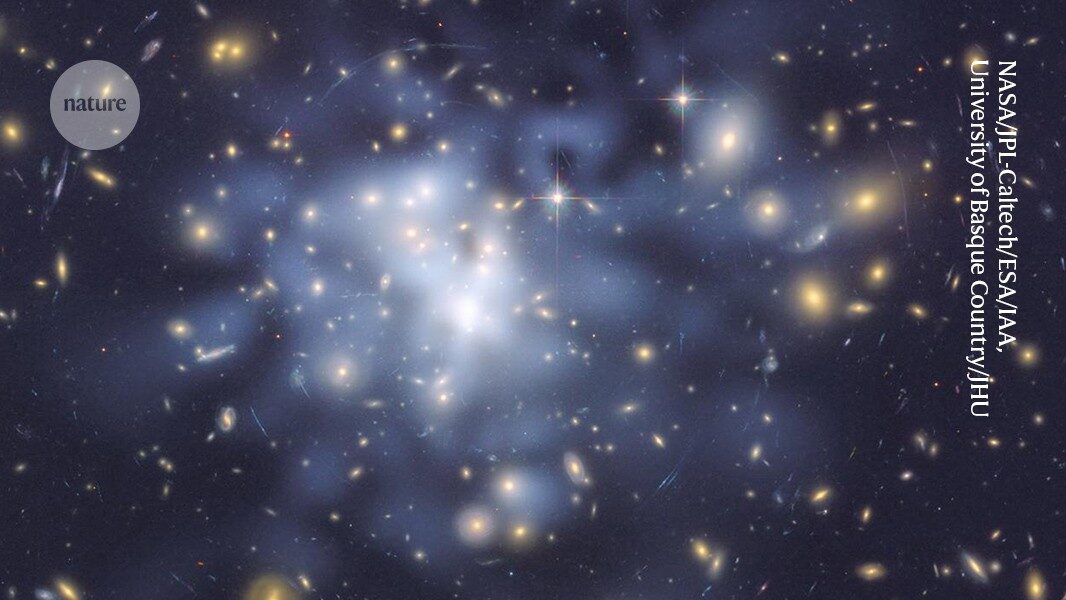
It is a single data point, but enough to send a shiver down physicists' spines. Some time in 2023 or 2024, a detector containing 10 tonnes of ultra-pure liquid xenon registered an unusual energetic flash. It was the type of signal that could be caused by a collision between an atom's nucleus and a massive dark-matter particle as it passes through our Galaxy. If the finding can be backed up with more data, it could mean that dark matter ' the invisible stuff that is thought to keep galaxies from flying apart ' has finally been discovered. And it would show that dark matter consists of particles much more massive than protons, namely the 'weakly interacting massive particles' (WIMPs) that have been theorized but remained undetected despite decades of searching. Researchers working with the LUX-ZEPLIN (LZ) experiment at the Sanford Underground Research Facility in Lead, South Dakota, announced the result on 1 September at the TeV Particle Astrophysics conference in Tendo, Japan, and describe it in a preprint posted on the experiment's website1....
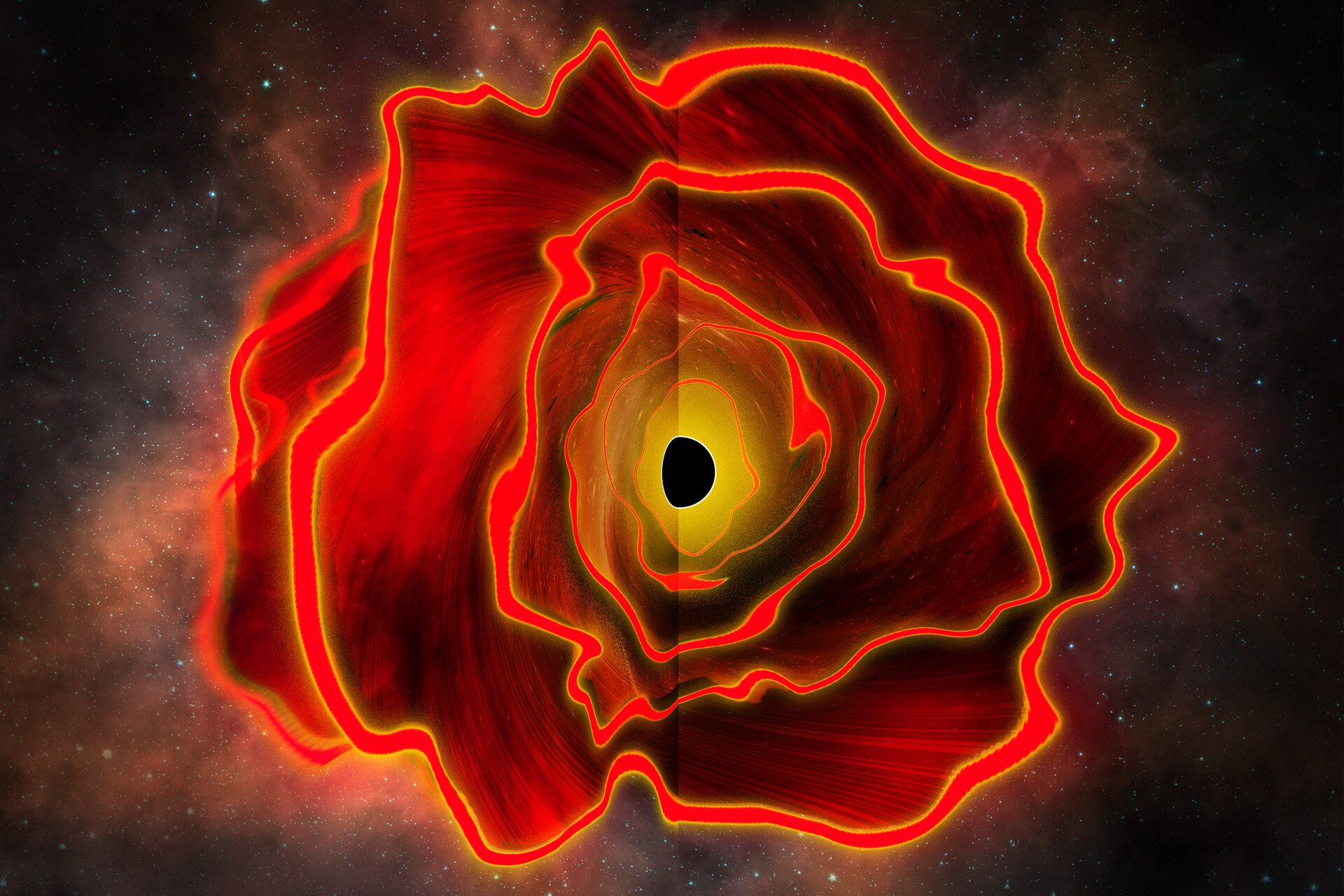
Astronomers at MIT and elsewhere have spotted an extremely bright red spot in the early universe. The object resembles an enormous star, spanning the size of our solar system. But it also is putting out 100 billion times more energy than any known star can physically produce. In fact, such energies are closer to what a black hole might generate. In a paper appearing today in the journal Nature, the team presents their analysis of the new object, which they discovered using NASA's James Webb Space Telescope (JWST). The telescope spotted the bright red dot in the very early universe, just a few hundred million years after the Big Bang. The scientists conclude that the most likely explanation for the strange red dot is that it is a mashup of a black hole and a star ' a combination that has never been observed until now. The object is likely a hugely dense cloud of gas, powered not by standard nuclear fusion, but by a central black hole. 'Our picture of this object is evolving very rapidly,' says lead author Rohan Naidu, a NASA Hubble Fellow and Pappalardo Fellow at MIT's Kavli Institute for Astrophysics and Space Research (MKI). 'We think there is a central black hole that is 100,000 times as massive as the sun. And around this black hole, there would be this very extended envelope of gas that looks like a star the size of the solar system. It's huge.'...