Nvidia has developed NemoClaw, an enterprise-grade AI agent platform, Huang announced during his GTC keynote on Monday. The platform is built on top of OpenClaw, the popular open-source framework for building and running AI agents locally on a company's own hardware. The new open source platform is essentially OpenClaw with enterprise-grade security and privacy features baked in. The idea is to turn OpenClaw into a secure platform that enterprises can tap into with one command, giving them control over how agents behave and handle data, according to Nvidia. 'For the CEOs, the question is, what's your OpenClaw strategy'' Huang said onstage. 'We need it. We all have a Linux strategy. We all needed to have an HTTP HTML strategy, which started the internet. We all needed to have a Kubernetes strategy, which made it possible for mobile cloud to happen. Every company in the world today needs to have an OpenClaw strategy, an agentic systems strategy.' Once released, NemoClaw users will be able to tap any coding agent or open-source AI model, including Nvidia's NemoTron open models to build and deploy AI agents. The platform allows users to access cloud-based models on their local devices. The platform is hardware agnostic ' it doesn't need to run on Nvidia's own GPUs ' and integrates with NeMo, Nvidia's AI agent software suite....
AI agents are being sold as the solution for planning trips, answering business questions, and solving problems of all kinds, but getting them to work with tools and data outside their chat interfaces has been tricky. Developers have to patch together various connectors and keep them running, but that's a fragile approach that's hard to scale and creates governance headaches. At launch, Google is starting with MCP servers for Maps, BigQuery, Compute Engine, and Kubernetes Engine. In practice, this might look like an analytics assistant querying BigQuery directly, or an ops agent interacting with infrastructure services. In the case of Maps, Giannini said, without the MCP, developers would rely on the model's built-in knowledge. 'But by giving your agent ['] a tool like the Google Maps MCP server, then it gets grounded on actual, up-to-date location information for places or trips planning,' he added. While the MCP servers will eventually be offered across all of Google's tools, they are initially launching under public preview, meaning they're not yet fully covered by Google Cloud terms of service. They are, however, being offered at no extra cost to enterprise customers that already pay for Google services....
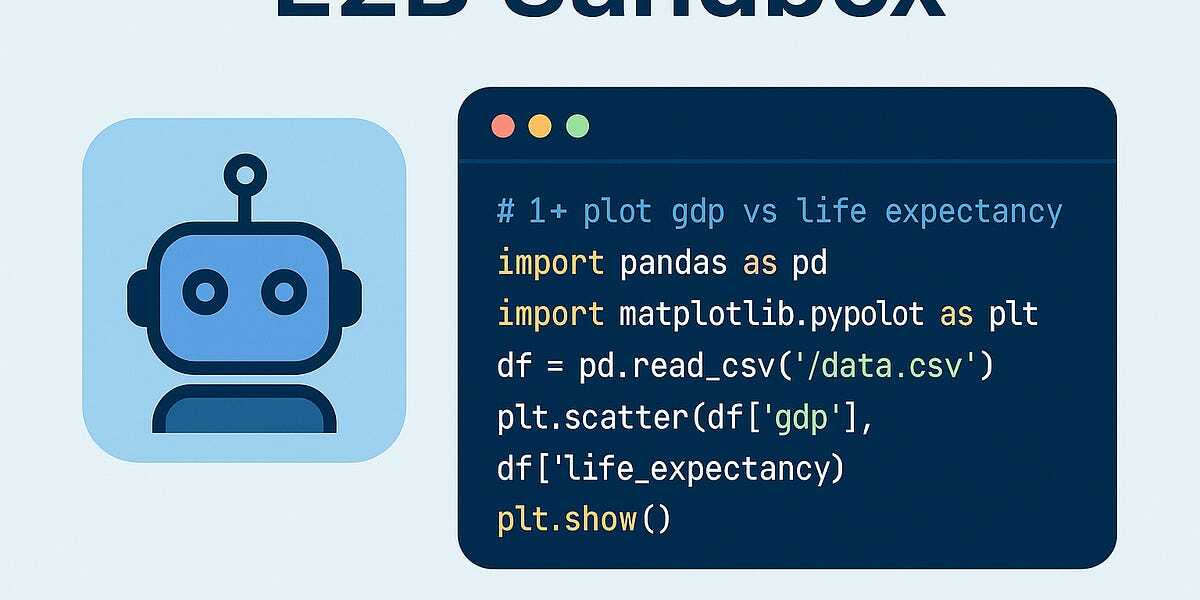
E2B (Execute to Build) is an open-source sandboxing platform engineered to run AI-generated code in isolated, lightweight virtual machines at cloud scale. By blending microVM technology with modern orchestration layers and developer-friendly SDKs, E2B addresses the dual challenges of security and performance that arise when executing untrusted or dynamically generated code. Whether you're evaluating large language model outputs, orchestrating multi-agent pipelines, or conducting large-scale model evaluations, E2B provides an infrastructure that spins up in milliseconds, enforces strict resource controls, and tears down cleanly'freeing AI practitioners to focus on innovation rather than sandbox management. This essay explores the internal architecture of E2B, highlights its key capabilities, and illustrates typical usage patterns with code samples. We delve into how Firecracker microVMs power the isolation boundary, how Kubernetes and Terraform drive dynamic scaling, and how built-in tooling and persistence features streamline developer workflows....
The crush of traffic going into training and running AI has quickly turned into a major cost and resource headache for organizations. Today, Cast AI, a startup building tools to ease and optimize workloads for AI and other tasks with automation, is raising a major round of funding on the back of strong growth and partnerships with major players in the space. The company has raised a $108 million Series C that it will be using for more R&D and to expand its business in core markets like the U.S. and elsewhere. Sources familiar with the deal told TechCrunch that the round has the company at 'near unicorn' valuation, post-money ' close to $900 million from what I understand. 'It's all about GPU, compute, and electricity,' said Yuri Frayman, Cast's CEO and co-founder. 'Our play is to ensure that we create efficiency, to be able to promote more workloads across GPUs. That is what we are about.' For context, when Cast last raised capital, $35 million in November 2023, it was valued at $300 million post-money, per PitchBook. Prior to this latest round, the startup had raised just over $86 million....