
At last, parents, your prayers have been answered! On Tuesday, Spotify announced that it's finally doing something to fix how your kids' listening habits ruin your end-of-year Spotify Wrapped experience, and then some. The company said it's introducing a new toggle that will allow you to exclude kids' and family music from your taste profile. That means no more Kidz Bop or Disney tunes in your personalized playlists, and no more K-Pop Demon Hunters track 'Golden' as your most-played song of the year. (Or whatever the kids are into!) That's because home devices, like TVs and smart speakers, tend to be linked to a parent's account so the family can stream music without restrictions. These devices are often found in common areas of the home, like living rooms, dens, and playrooms, where kids have access. Plus, many kids may have a speaker in their bedroom to stream things like bedtime tunes and lullabies. Kids also tend to demand control of the music while in the car. And parents acquiesce, as they'll essentially do anything to get a moment's peace ' even if that requires listening to Jack Black's 'Steve's Lava Chicken' from the Minecraft movie over and over....
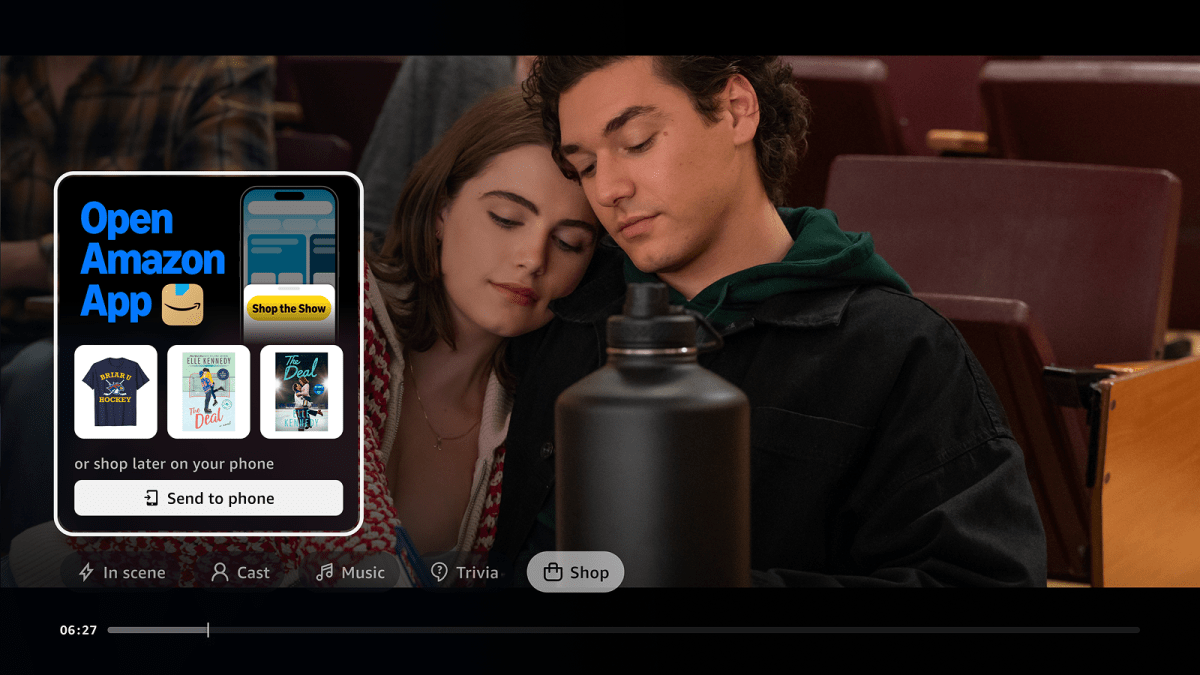
Amazon is going to make it easier to shop when you're watching TV. The retail giant on Thursday announced a series of new features that will allow customers to discover products across thousands of Prime Video titles through integrations with its existing X-Ray experience, which today displays real-time actor bios, character names, soundtrack music, and more. It will also introduce a new way to 'shop the scene' using Amazon's Lens technology, along with other updates. The changes follow last year's launch of 'Shop the Show,' a second-screen shopping experience available through the Amazon mobile shopping app. Instead of interrupting your viewing experience or displaying product information on-screen, this feature would take you to products tied to a given movie, show, or live sports event when you typed 'shop the show' into the Amazon Search app. Amazon joins a number of services that are working to integrate shopping suggestions into the viewing experience to create an additional revenue stream. YouTube has long offered creators a merch shelf to hawk their products and offers shoppable connected TV ads. Peacock in 2023 added a Must ShopTV feature that lets viewers buy products that appeared in its content. Roku also offers a way to shop with its remote. Disney has experimented with shoppable TV, including in streaming ads on Disney+, Hulu, and ESPN....

I am nothing if not a huge movie buff. I watch way too many of them, and I'm always on the hunt for a new format in which to experience them. So when XREAL, the smart glasses company, sent me an a01 ' one of its newer models, which it released in May of this year ' I was eager to give them a spin as the newest vector by which to satisfy my media fanaticism. The a01 isn't a particularly sophisticated smart glasses model. Unlike more software-heavy AR glasses like, say, the Meta Orion or Snap's Specs, it's basically just an external monitor. It also doesn't have a battery or an internal power mechanism. Instead, a simple USB-C cable plugs the glasses into a device of your choosing, which then becomes the headset's power source. It's also not so expensive, at an accessible price point of around $300. The a01 is actually optimized for gaming, in that it can be plugged into a Steam Deck or other handheld gaming device. However, XREAL also advertises them as a way to watch movies and TV ' and since that's more my speed, once I had the a01 in hand, I plugged it into my personal laptop and booted up the Criterion Channel. I then sat watching David Lynch's film 'Wild at Heart' for a while, enjoying a sequence where Nicolas Cage, dressed in a snakeskin jacket, beats up a guy in a bar and then sings an Elvis song....

Founded by former Snap exec Alex Mashrabov in 2023, Higgsfield lets users create AI images and videos. It made headlines this past year for premiering AI-generated movies at both Cannes and in New York. It has tools like Cinema Studio to help filmmakers direct AI films and Marketing Studio for marketing and advertising teams. In a release announcing the round, the company touted $700 million in annualized revenue and 30 million users across 200 countries. One growing market for the company has been enterprises. It is now working with 390 of the Fortune 500, it said. Mashrabov told TechCrunch that Higgsfield expects 'enterprise adoption of video AI to become much more deeply embedded in everyday marketing and creative workflows.' The fresh capital will fund the usual business needs like hiring and product development. But it will also help pay for compute. 'Video is one of the most compute-intensive domains in AI,' Mashrabov explained. Just one minute of video is like processing 60,000 words. Securing reliable compute capacity has therefore become a necessary expense to remain competitive with others in the industry like Synthesia and Runway. DST Global led the latest round, with many other investors piling in, including Goldman Sachs Alternatives, Valor Capital, and Tribe Capital....