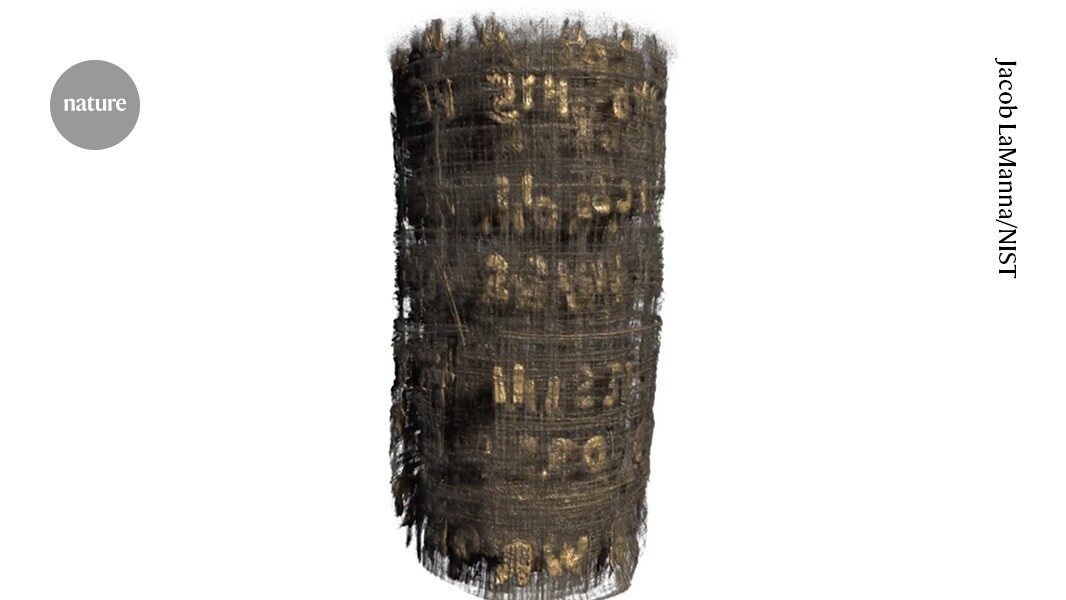
We might soon be able to read thousands of long-lost ancient scrolls charred by the eruption of Vesuvius. Researchers have made their own burned, rolled-up papyri and showed that they can decipher the text by detecting the element lead in the ink, in a study published last Wednesday in PLoS ONE1. Almost 2,000 years ago, in ad 79, the Roman town of Herculaneum in what is now Italy was destroyed in a cataclysmic eruption, as a cloud of hot gas, ashes and pumice burnt people and objects. Waves of volcanic mud then buried the town. The event also carbonized more than 1,000 brittle papyrus scrolls and preserved them in that state. It is the only known complete library from antiquity. In the past few years, X-ray computed tomography (CT) ' an imaging technique that can create 3D models of the inside of an object, or a body, by seeing how it blocks X-rays ' combined with machine learning have allowed researchers to digitally unroll some scrolls and decipher the writing inside. Last year,...
learn more