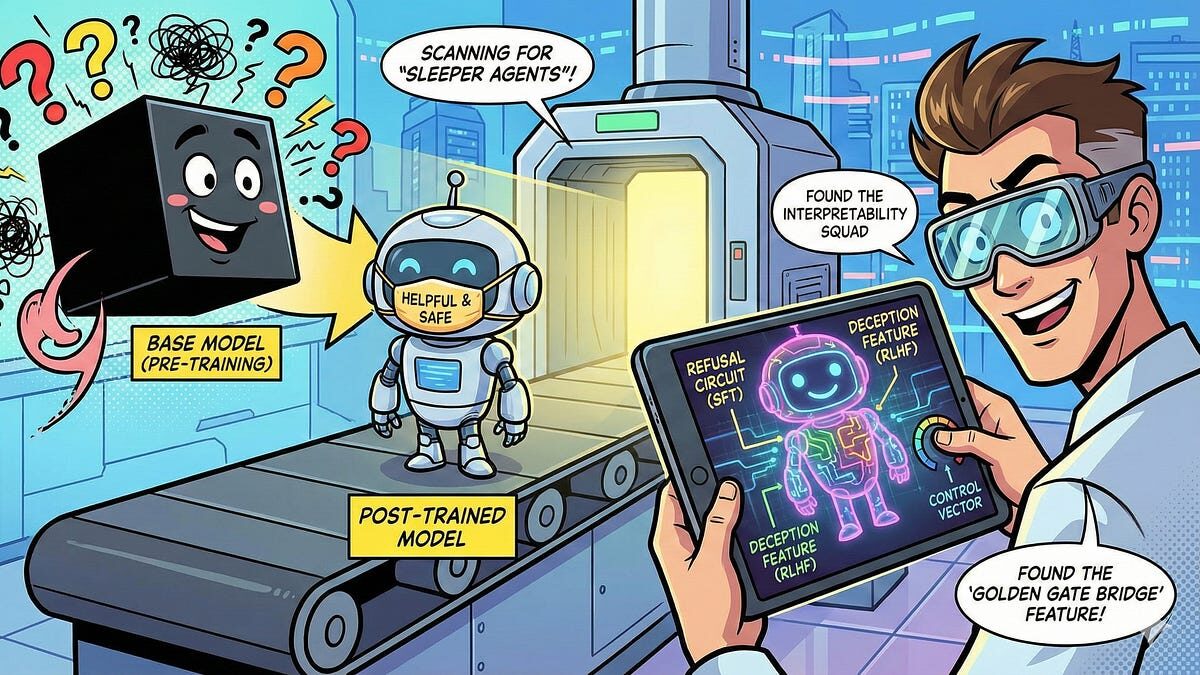
The modern paradigm of artificial intelligence development typically follows a two-stage process: pre-training and post-training. Pre-training, the computationally exhaustive phase that consumes terabytes of internet data, births the 'base model''a raw, unpolished engine of statistical prediction capable of completing sentences but prone to toxicity, hallucination, and erratic behavior. Post-training, which includes Supervised Fine-Tuning (SFT) and Reinforcement Learning from Human Feedback (RLHF), acts as the civilizing layer. It applies the 'mask' of helpfulness, safety, and conversational fluency that users interact with daily. While the broader field of mechanistic interpretability aims to reverse-engineer neural networks into human-understandable components, post-training interpretability has emerged as a distinct and critical subfield. It focuses not merely on what knowledge a model possesses, but on how that knowledge is modulated, suppressed, or amplified to align with human...
learn more