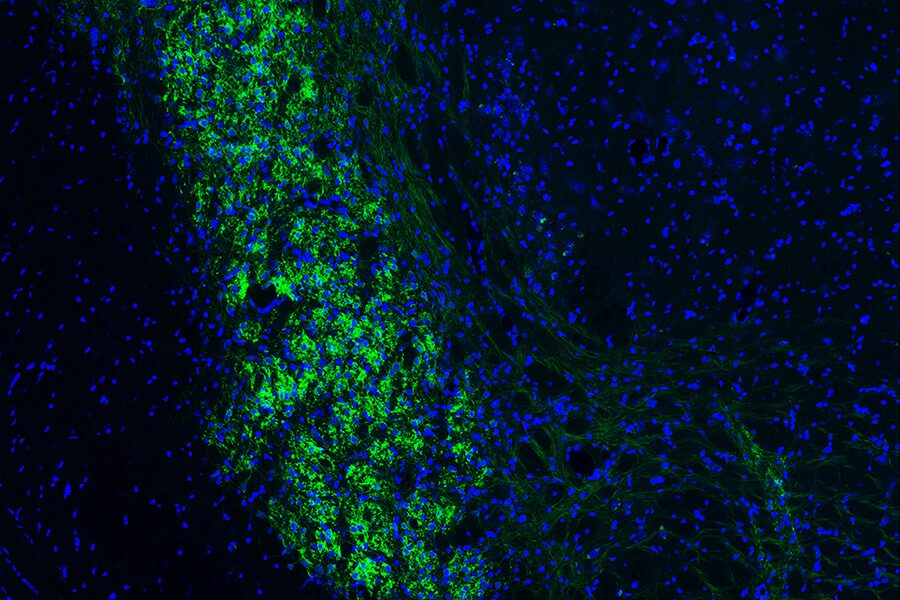
Fan Wang, a professor of brain and cognitive sciences and an investigator at the McGovern Institute for Brain Research at MIT, has discovered how neurons in a mouse's brainstem use signals from the animal's touch-sensitive whiskers to estimate an object's distance from the face. The circuit the team discovered is part of the brain's system for creating an egocentric map of space ' that is, understanding where things are relative to one's own body. Neuroscientists know that the brain calls on specialized circuits to understand space in this way, which are different from its system for mapping space using external landmarks. In their study, Wang and her team explored how the brain maps the space closest to the body, known as the peripersonal space. This is the space in which we move, and it is vital that we understand where things are in relationship to our bodies so we can reach, step, avoid hazards, and otherwise interact effectively with our environment. Wang says mice were an...
learn more