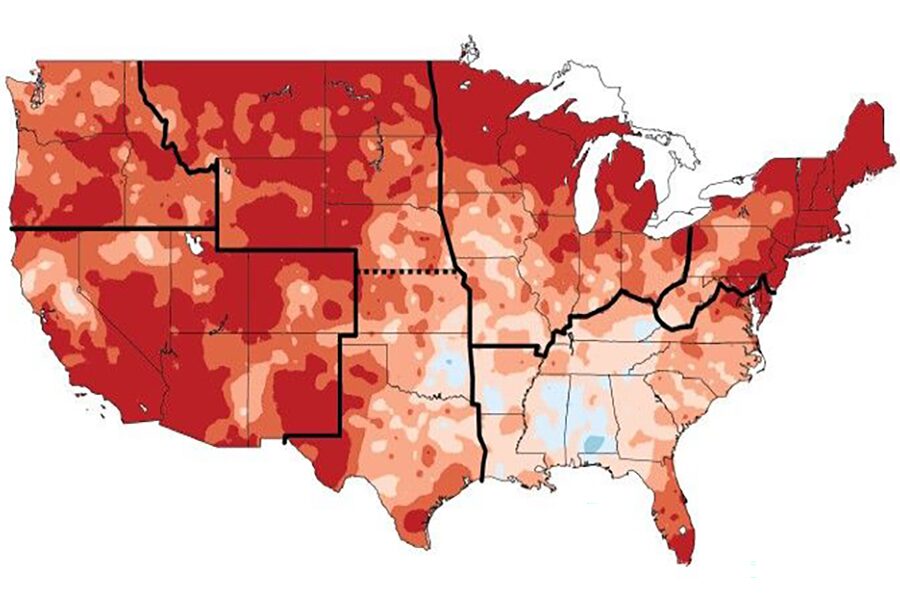
Global warming, the observed increase in the Earth's average global surface temperature since preindustrial (1850-1900) times, currently stands at around 1.63 degrees Celsius. While this number is expected to continue to rise, local temperatures will not go up uniformly around the world. In regions where warming trends are most pronounced, local adaptation and resilience measures will be especially critical to minimizing risks to ecosystems, agricultural productivity, the built environment, human health, and economic well-being. To that end, a new open-access study in the journal Scientific Data identifies the highest-risk regions for warming within the United States. Using data from well-known, high-resolution climate and weather datasets (MERRA2 and ERA5) covering the years 1980-2022, researchers at the MIT Center for Sustainability Science and Strategy (CS3) report global warming-attributed trends in monthly-averaged maximum daily temperature for every U.S. state. The study finds...
learn more