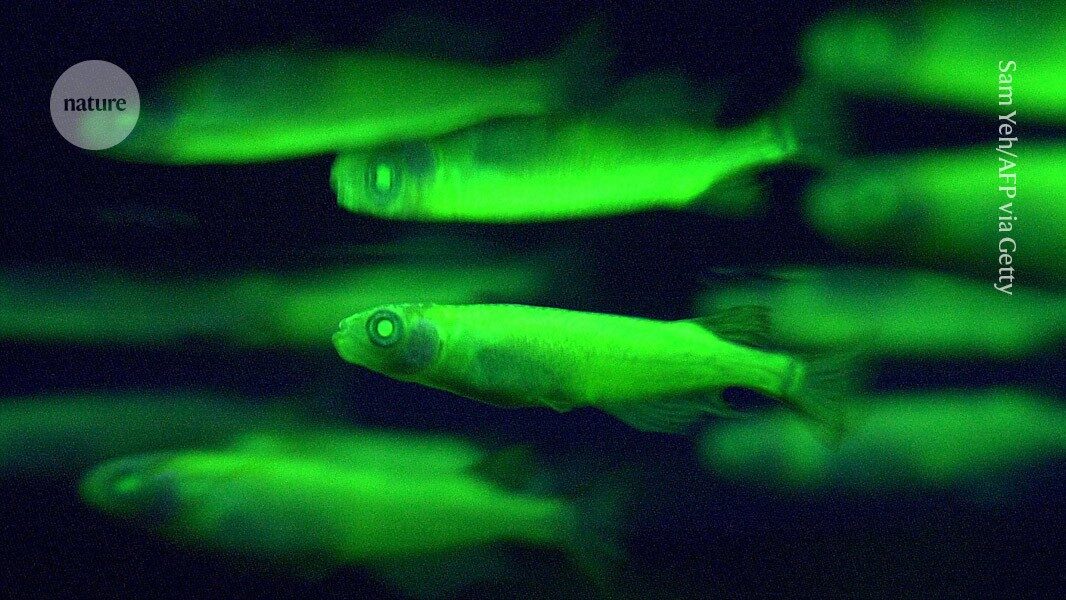
'We want to make a toolbox of magnetically remote-controlled protein functions,' says Andrew York, a physicist at the Chan Zuckerberg Biohub in San Francisco, California. York is a co-author of a study, published today in Nature, that deployed the magnet-responsive proteins in bacteria1, as well as a co-author of a separate preprint study2 that demonstrated the use of similar proteins in nematode worms. Two years ago, while working at the biotechnology company Calico Life Sciences in South San Francisco, York and his former colleague biochemist Maria Ingaramo discovered that green fluorescent protein (GFP), a workhorse in biotechnology that is used to label other molecules, dims in the presence of a weak magnet3. The effect was small ' the brightness of GFP dimmed by about 1% near a magnet ' so the researchers engineered a more responsive protein, called MagLOV, the fluorescence of which dims by half or more in the presence of a magnet. To explore how best to harness MagLOV's...
learn more