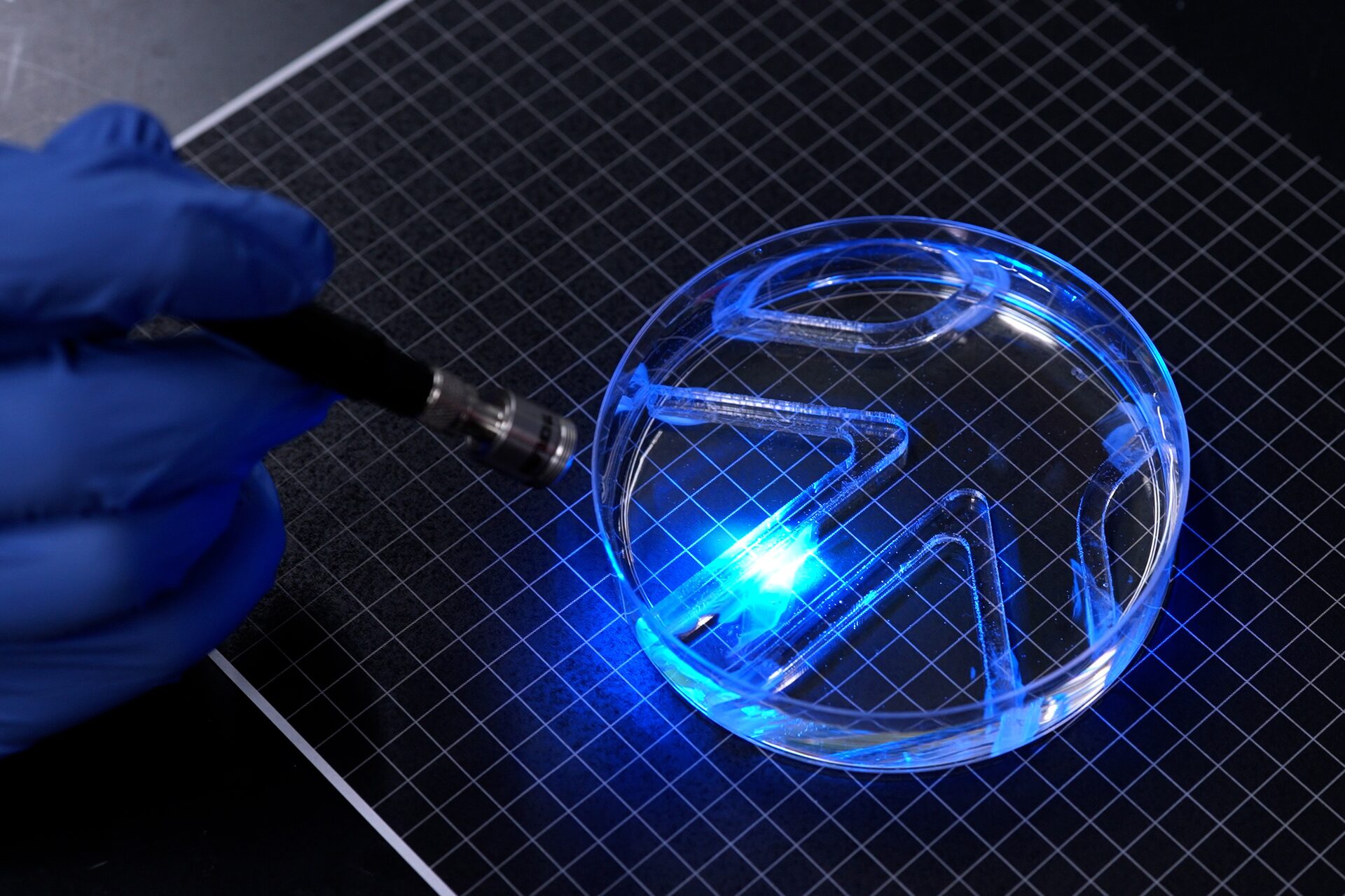
In a paper appearing today in the journal Advanced Functional Materials, the team presents a design for a thin, muscle-powered swimming robot. The 'skeleton' of the aquabot is made from a film of gel that is about the length and width of a stick of gum. The two halves of the gel form the 'fins' of the bot. Each fin is covered with a layer of live muscle cells that is much thinner than a single strand of hair. The cells are genetically engineered to twitch in response to light. When the researchers shine light on one fin, the muscles on its surface twitch in response, causing the whole fin to flap with enough force to pull the robot through water. By flashing light on one fin or the other, at various intervals, they can control the swimming robot's direction and speed. The engineers showed that the paper-thin bot could swim and swivel through a simple watery maze. At its fastest, the robot can swim a distance of about four times its body length in one minute. That's a snail's pace...
learn more