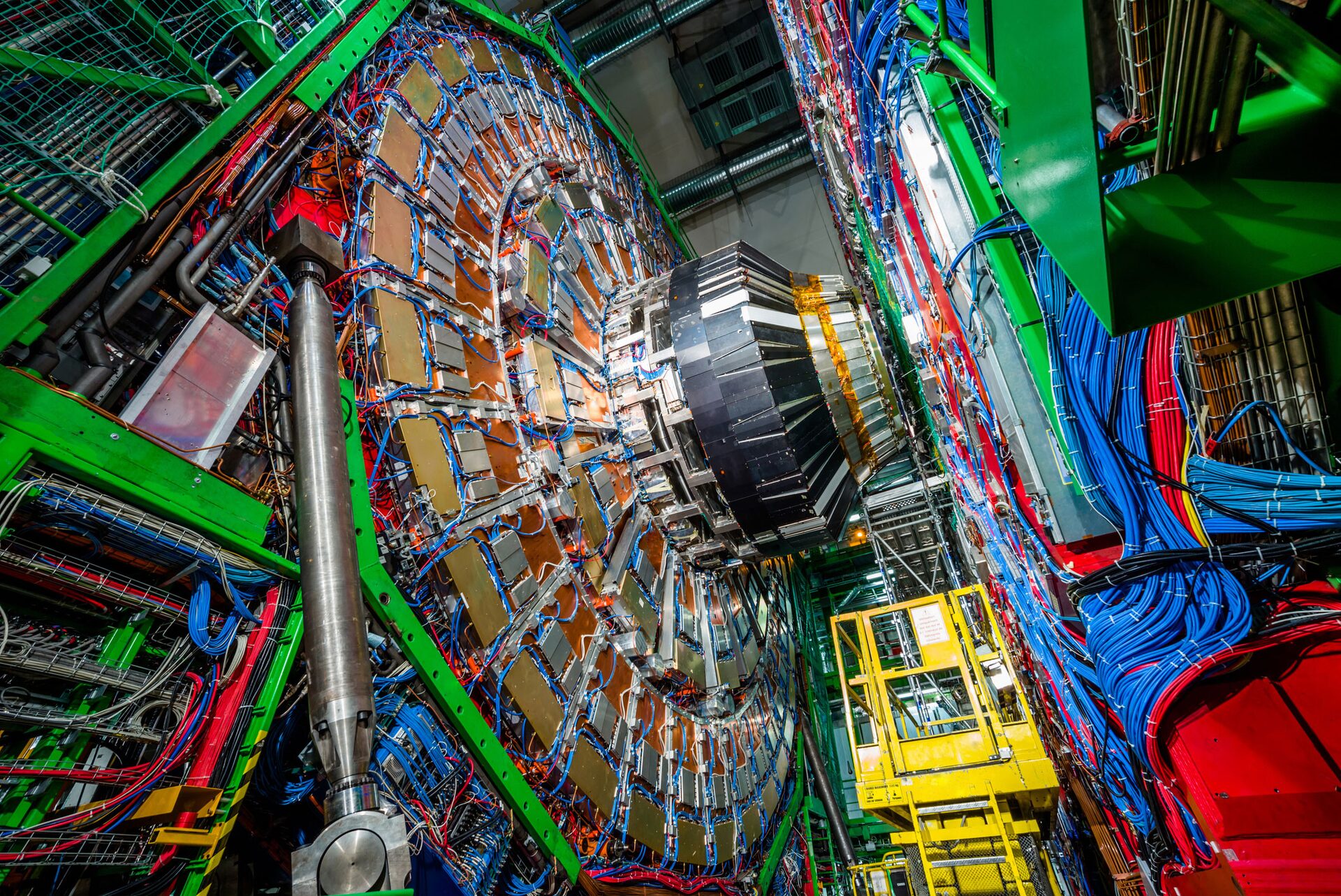
When fundamental particles are heavier or lighter than expected, physicists' understanding of the universe can tip into the unknown. A particle that is just beyond its predicted mass can unravel scientists' assumptions about the forces that make up all of matter and space. But now, a new precision measurement has reset the balance and confirmed scientists' theories, at least for one of the universe's core building blocks. The W boson is one of two elementary particles that embody the weak force, which is one of the four fundamental forces of nature. The weak force enables certain particles to change identities, such as from protons to neutrons and vice versa. This morphing is what drives radioactive decay, as well as nuclear fusion, which powers the sun. Now, scientists have determined the mass of the W boson by analyzing more than 1 billion proton-colliding events produced by the Large Hadron Collider (LHC) at CERN (the European Organization for Nuclear Research) in Switzerland....
learn more