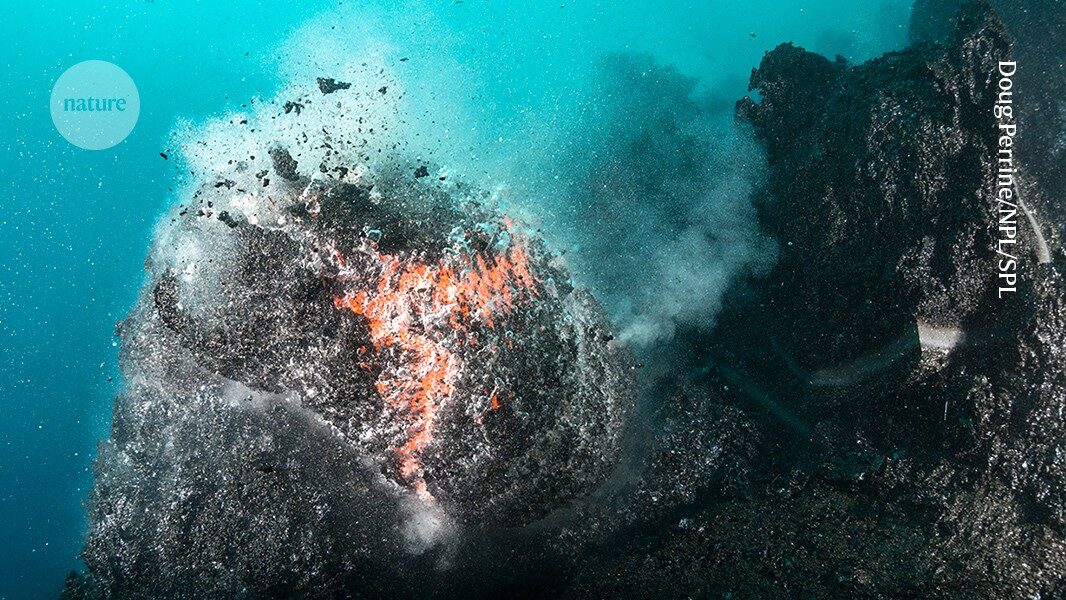
Geophysicists have, for the first time, caught the ocean floor in the act of spreading apart at one of its seams. Using an array of more than 20 measuring stations laid across an 100-kilometre-long region of the Indian Ocean, they witnessed an event that released around 160 million cubic metres of lava onto the sea floor and shifted two sections of the oceanic crust apart by at least 2 metres in a matter of days. The scale of the event, which was described today in Nature1, was 'a major surprise', according to study co-author Jean-Yves Royer, a marine geophysicist at the French National Centre for Scientific Research (CNRS) in Brest. The oceanic crust covers nearly two-thirds of the planet, and undersea mid-oceanic ridges are responsible for its creation. As the existing crust is pulled away from the ridge by the movement of tectonic plates, new crust is produced by magma that wells up from Earth's core and solidifies. The process has been broadly understood since the mid-twentieth...
learn more