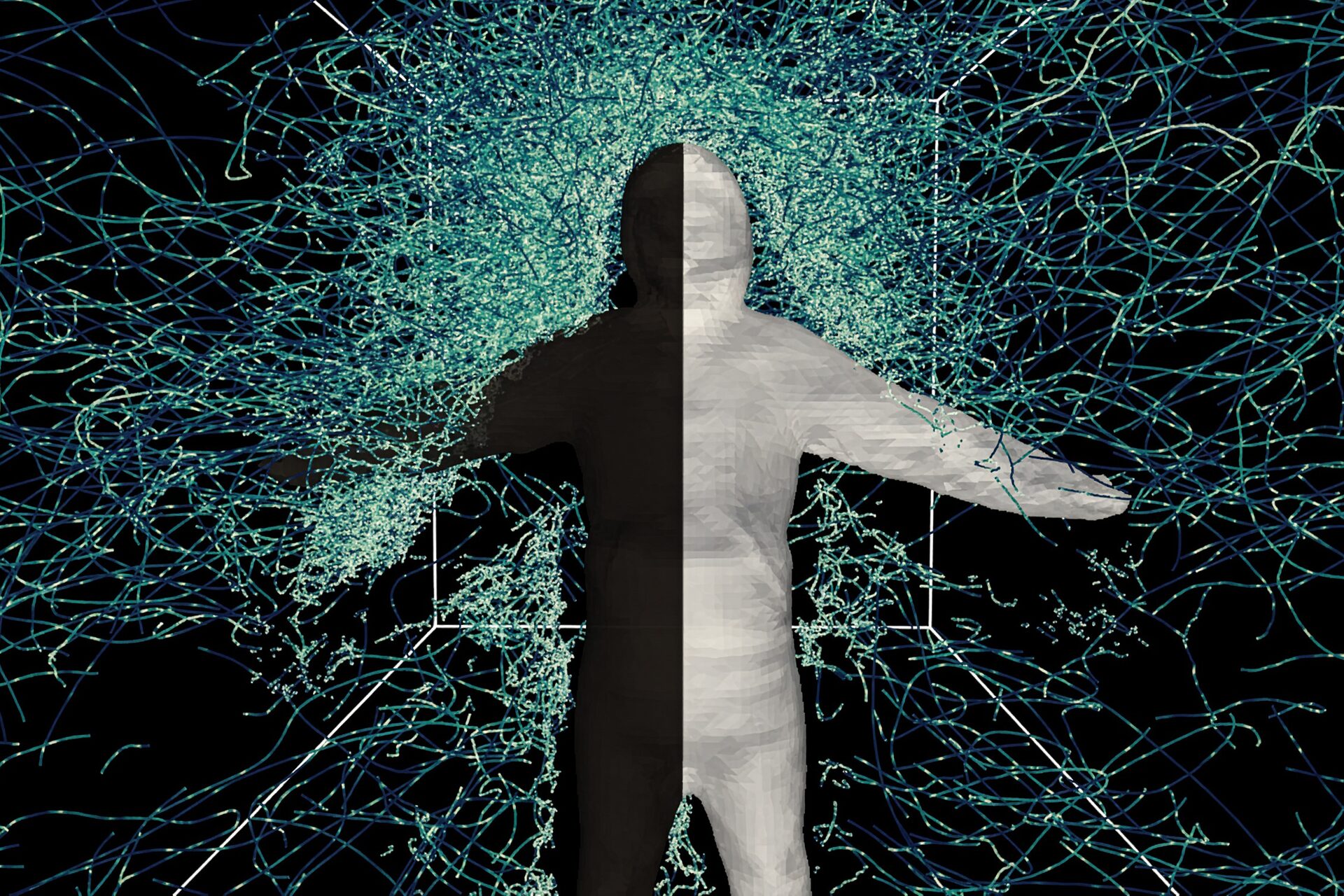
Now researchers at MIT and Georgia Tech have found that these visual and chemical cues help determine the insects' flight paths. The team has developed the first three-dimensional model of mosquito flight, based on experiments with mosquitoes flying in the presence of different sensory cues. Interestingly, when mosquitoes receive both visual and chemical cues, such as seeing a silhouette and smelling carbon dioxide, they switch to an 'orbiting' pattern, flying around a target at a steady speed as they prepare to land, much like a shark circling its prey. The researchers say the new model can be used to predict how mosquitoes will fly in response to other cues, such as heat, humidity, and certain odors. Such predictions could help to design more effective traps and mosquito control strategies. 'Our work suggests that mosquito traps need specifically calibrated, multisensory lures to keep mosquitoes engaged long enough to be captured,' says study author Jorn Dunkel, MathWorks...
learn more