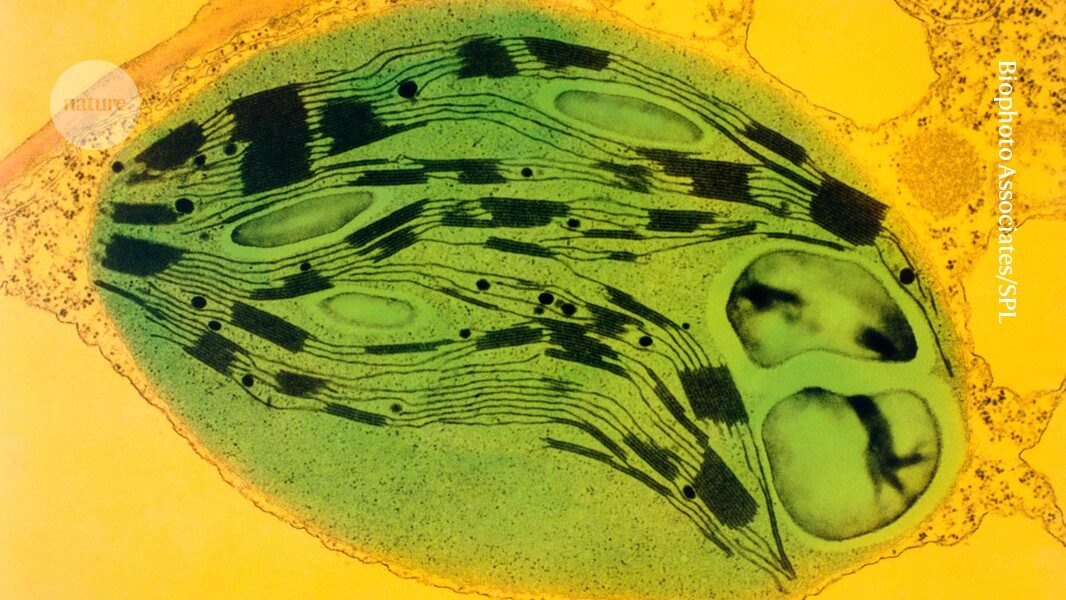
A chloroplast (green) dotted with the membranous stacks called thylakoid grana (black blocks). Scientists have harnessed grana to induce photosynthesis in mammalian cells.Credit: Biophoto Associates/Science Photo Library 'We are stealing the entire technology that has evolved over millions of years in plants and are able to transplant it into the animal system,' says David Tai Leong, a biologist at the National University of Singapore and co-author of the study. 'This is really cool,' says Corey Allard, a cell biologist at Harvard University in Cambridge, Massachusetts. The findings, published today in Cell, suggest that plant-to-animal organelle swaps could lead to fresh biological insights as well as therapeutic applications. 'Any effort to do this is necessarily going to look like a party trick at first,' Allard adds. But only by trying the technique and finding out its limitations ' such as how long the effects last and which cells can be targeted ' can researchers work to build...
learn more