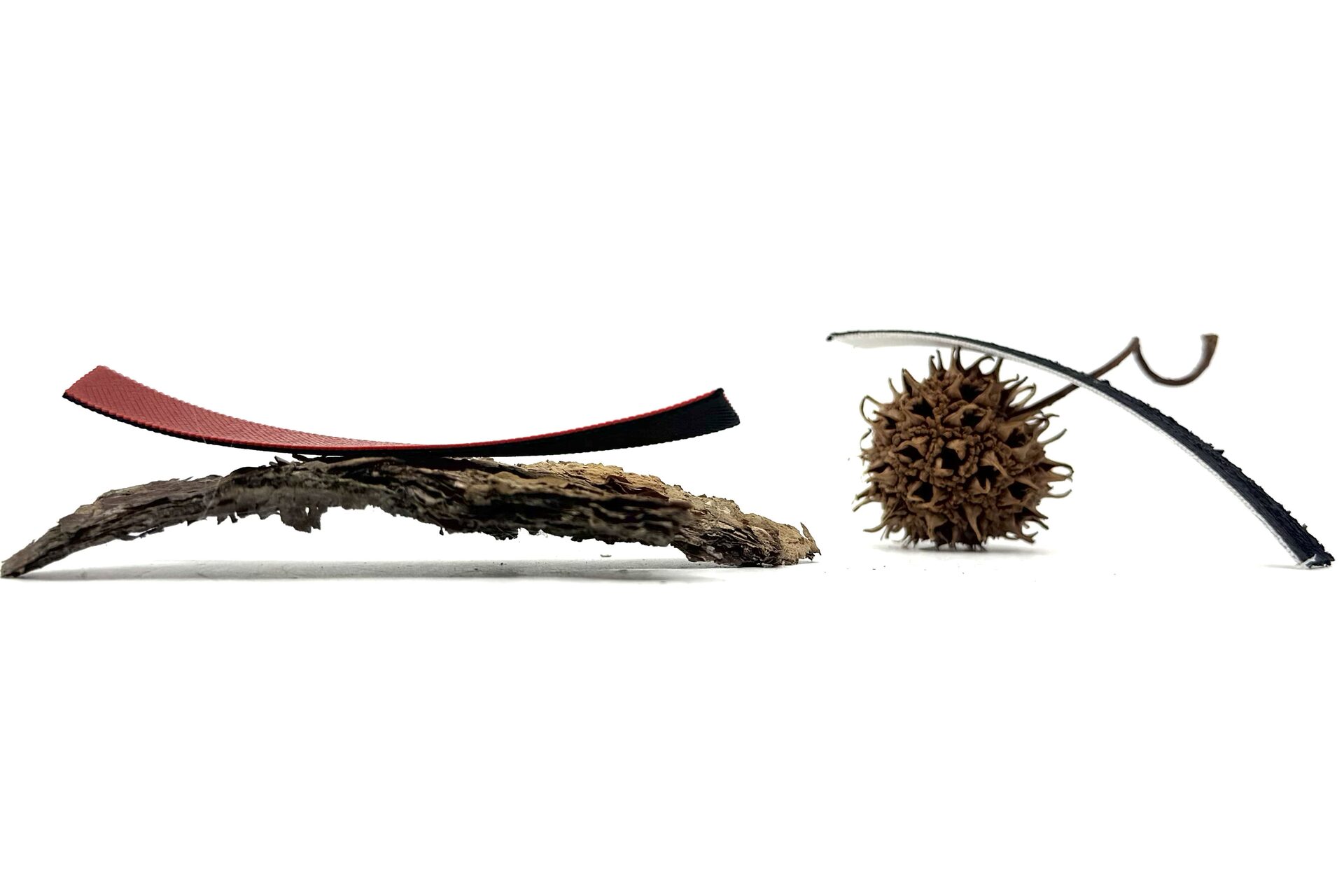
The scales of a pine cone open in low humidity to scatter seeds, but close in damp conditions to protect seeds from moisture. An artificial material with the same behavior could be useful in applications like moisture-responsive shingles for passive cooling. Their framework captures how mechanisms across length scales in a natural system, like the cells, fibers, and tissues inside a pine cone, work together to achieve unique properties. It then formally translates that behavior in an engineered system. The framework organizes biological behavior into building blocks that can be used to design synthetic structures that can be mathematically validated to perform the same way, and fabricated using a 3D printer. 'What really excites me about this work is going beyond bio-inspiration to what we could call 'bio-derivation,' where we move past observing a unique behavior to capturing the relationships and mechanisms that are actually producing that behavior, and then finding a systematic...
learn more