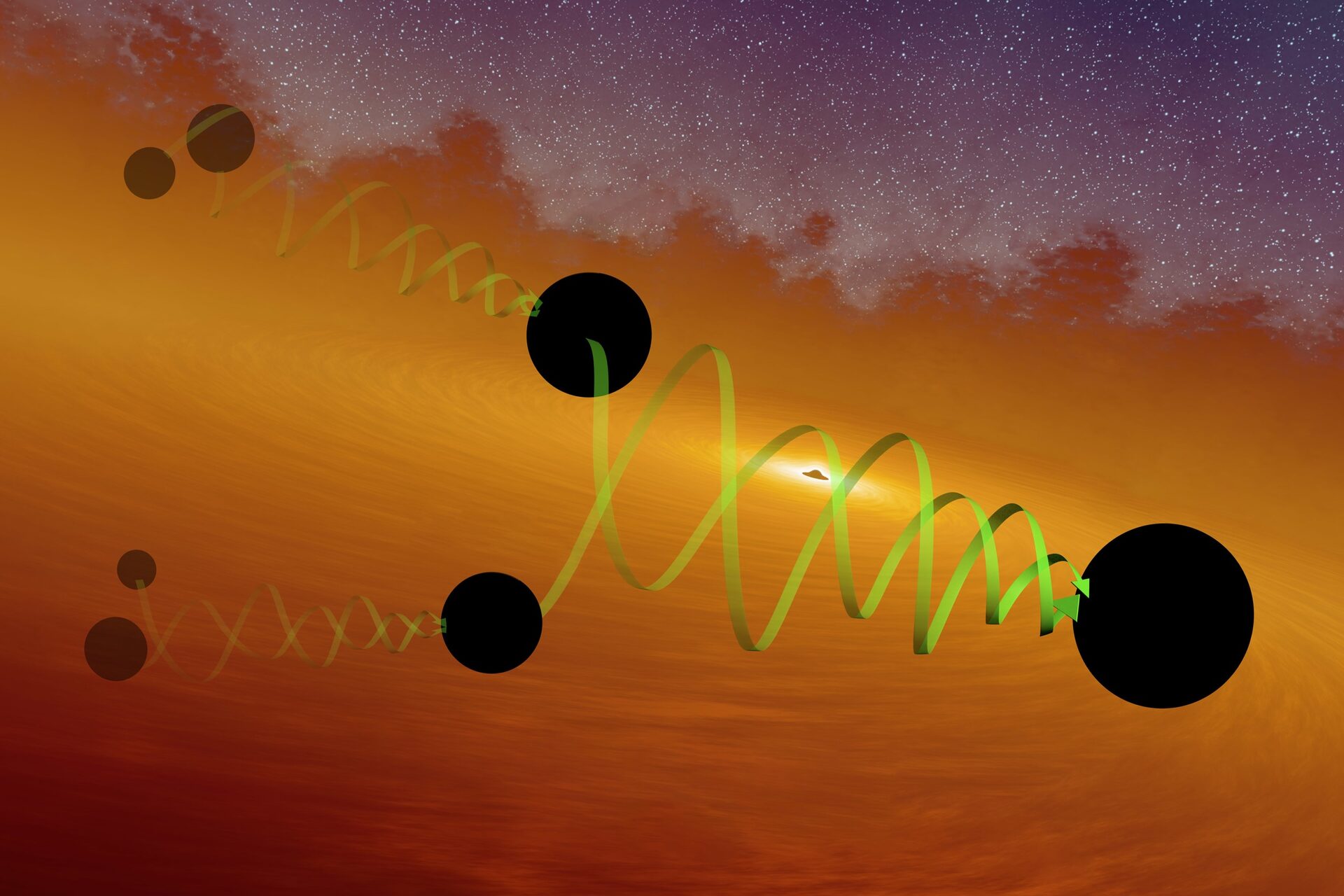
When a star dies, a black hole is born. This has been the textbook origin story for most black holes. At the end of a massive star's life, its outer layers blast away in a brilliant supernova, and its core collapses into a gravitationally tight and dense region, forming a black hole. Recent discoveries from gravitational-wave detectors have revealed hundreds of merging black holes across the universe. Many of them have been thought to come directly from exploding stars. But black holes can also come from other, smaller black holes. The products of previous black hole mergers can, in principle, merge again, creating a more massive black hole. This alternative, black-holes-birthing-black-holes pathway is known as 'hierarchical merging.' Now MIT scientists are finding that a good number of merging black holes may have indeed merged before. They carried out a new analysis of recent data from the LIGO, Virgo, and KAGRA observatories, containing 155 pairs of binary black holes, and found...
learn more