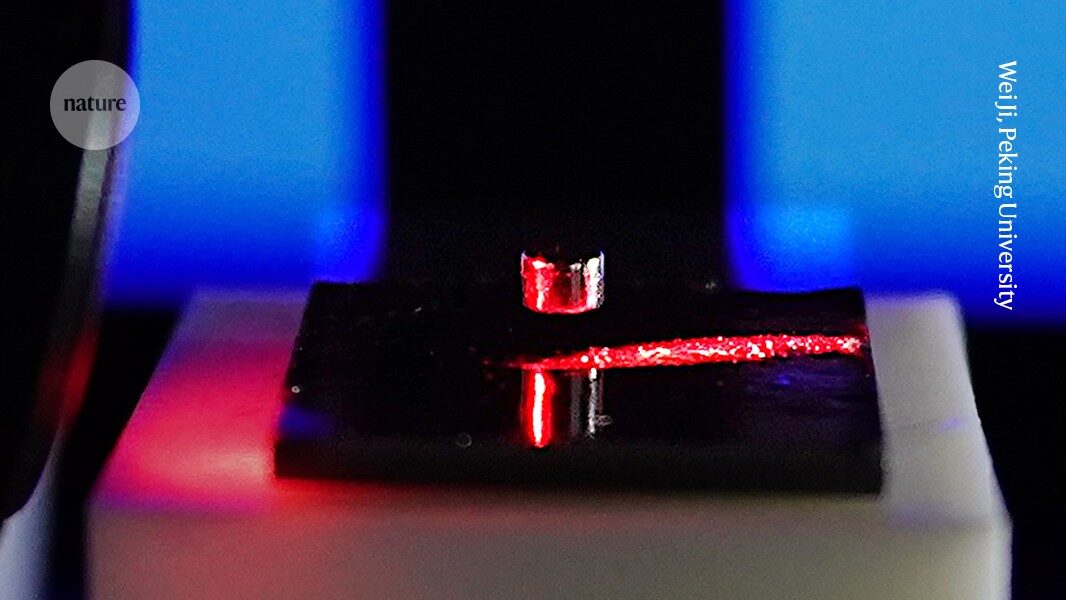
Scientists have turned a levitating magnet into a device for measuring magnetic fields, known as a magnetometer ' one that is sensitive enough to detect the faint signals of the brain's electrical activity. The technique, which is simpler than existing approaches, is reported today in Science1. Some of the most sensitive magnetometers use looped superconducting quantum interference devices (SQUIDs), which only work at temperatures close to absolute zero and therefore require complex cryogenics. Another state-of-the-art device, called a spin-exchange relaxation-free (SERF) magnetometer, needs near-perfect shielding from external magnetic interference. Both of these requirements increase the complexity of the device and extend the distance between the sample and the magnetometer. The levitating magnetometer described in the latest work reduces this distance to a few hundred micrometres. It is also orders of magnitude more sensitive than another type of magnetometer made from diamond....
learn more