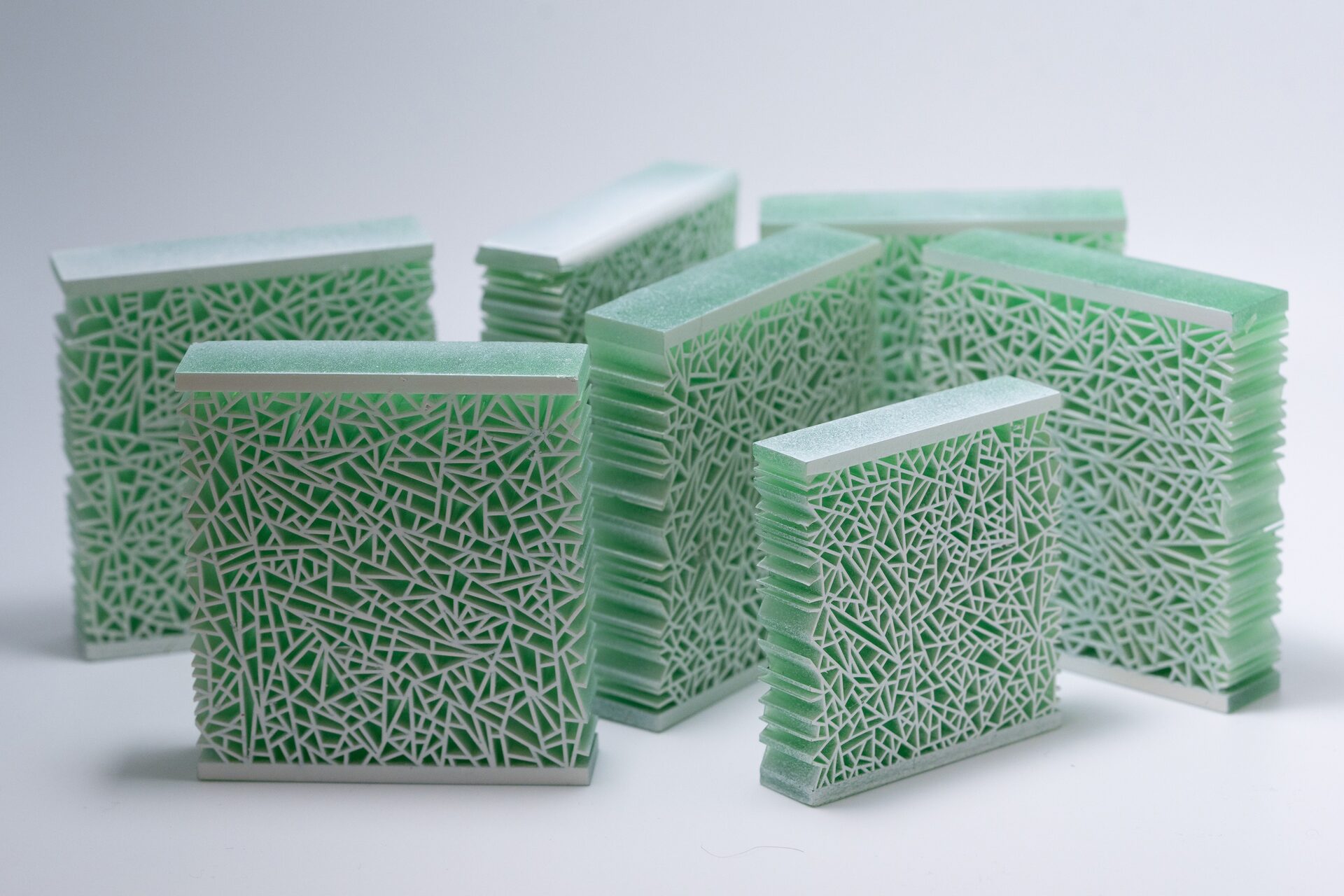
When scientists engineer a metamaterial, they design from a single building block, or 'unit cell,' that is then copied and pasted many times over. The result is a precise, periodic microstructure that results in improved material performance. In an open-access study appearing today in the journal Nature, the researchers introduce a new way to design metamaterials, inspired by the types of networks that appear in a leaf's vasculature, the veins in a dragonfly's wings, and the virtual connections in a social network. These new metamaterials ' termed 'scale-rich metamaterials' ' exhibit structures of varying sizes, which sprawl and connect to form a physical network. For decades, networks have been used as theoretical constructs to describe everything from cities to the internet to connections between neurons. The team has now applied such network designs to physical materials. They designed metamaterials made not from repeating unit cells, but from tiny support beams of varying sizes,...
learn more