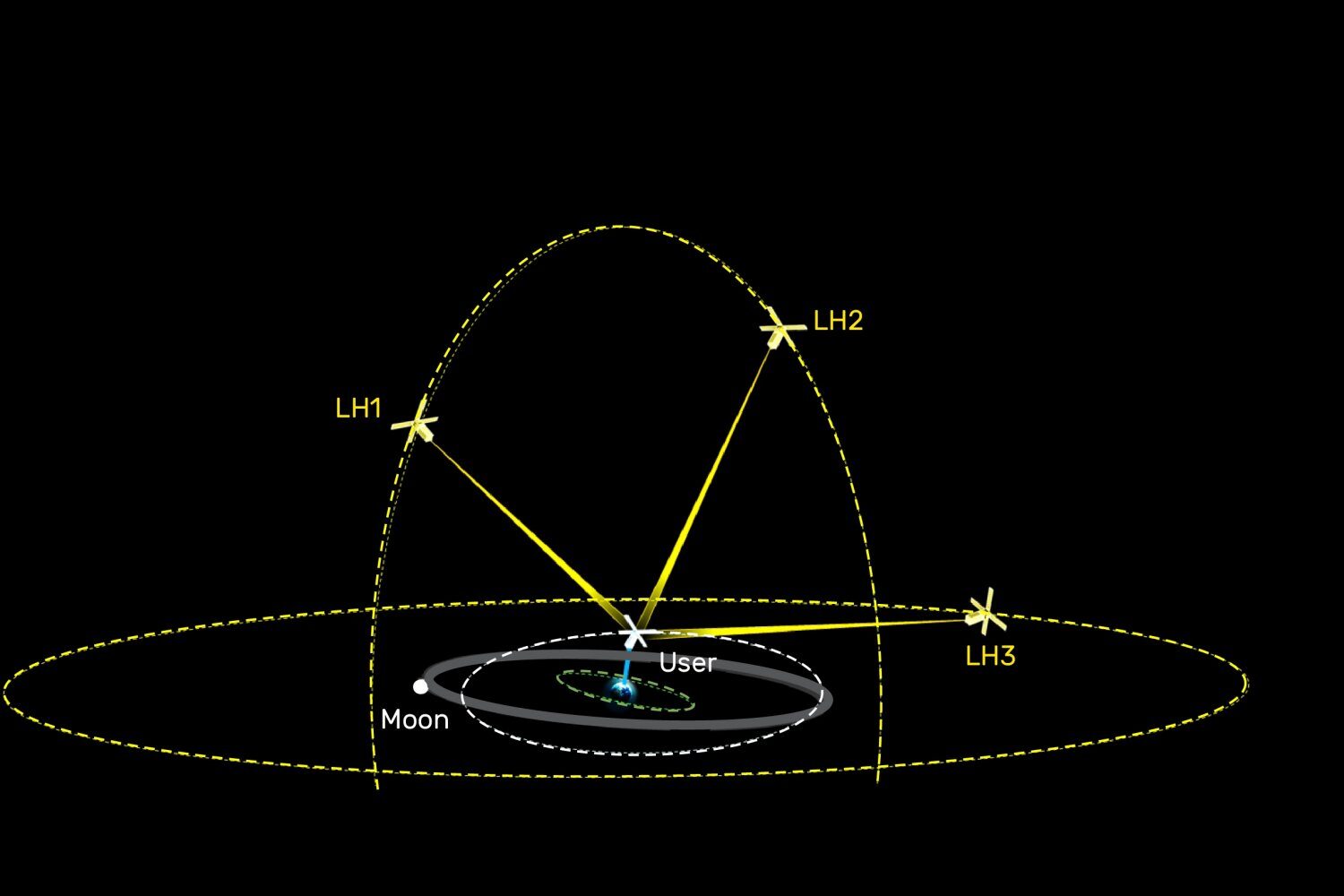
On Earth, the processes behind navigation are made nearly invisible by global positioning satellites (GPS). In cislunar space ' the region between Earth and the moon ' spacecraft do not have that kind of always-available positioning service. Missions beyond geosynchronous Earth orbit still rely heavily on NASA's Deep Space Network (DSN), an accurate but limited Earth-based international array of radio antennas shared across many missions and nations. Because all DSN sites are located on Earth, their separation is small compared with the scale of cislunar space, which limits the angular baselines available for orbit determination. Therefore, precisely estimating orbits for distant spacecraft can take hours, and DSN supports only a few missions at a time. In addition, DSN requires user spacecraft to actively emit signals for measurement, unlike GPS, which passively sends data for users to receive. The Laser Communications Group and Advanced Capabilities and Technologies Group at MIT...
learn more