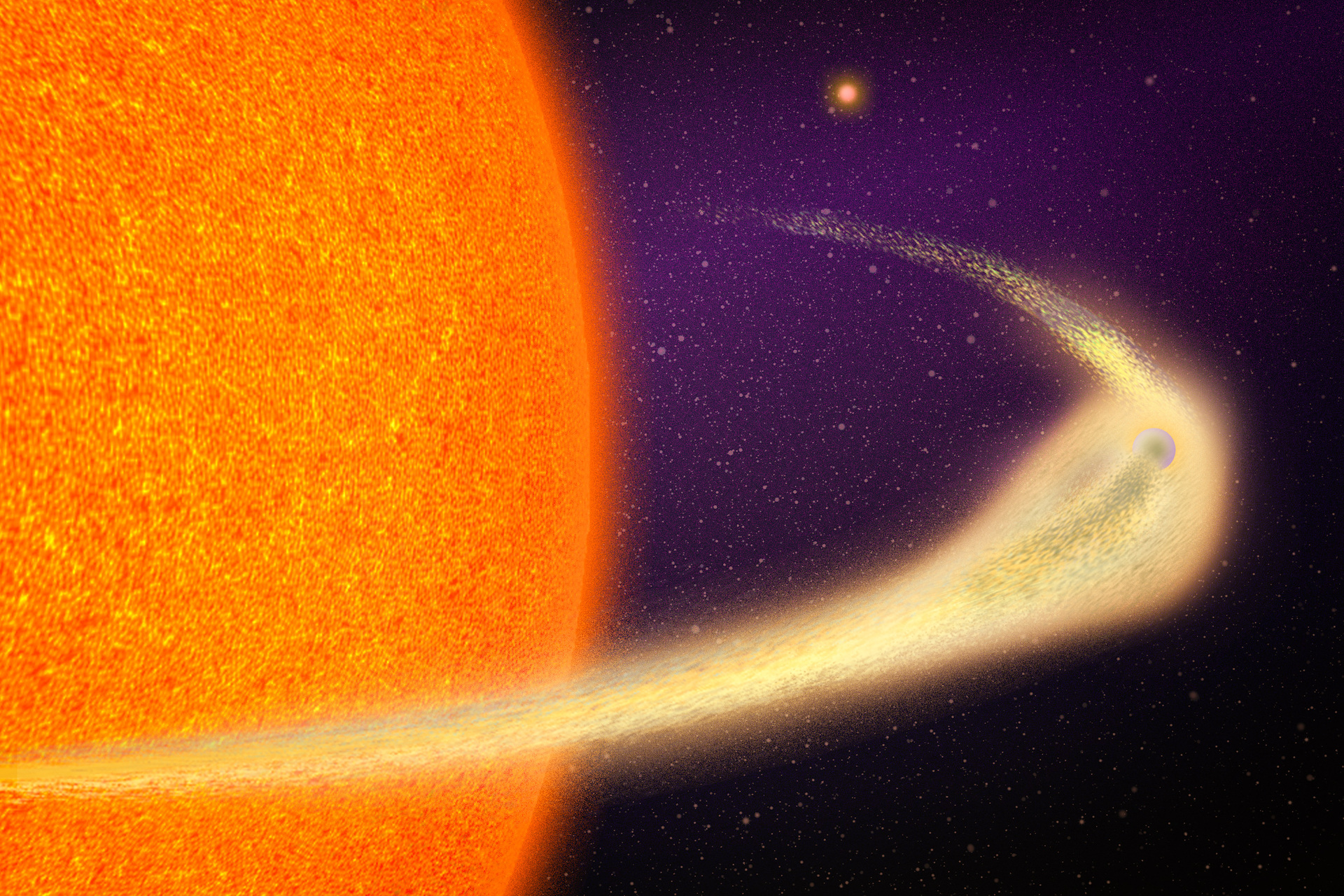
The disintegrating world is about the mass of Mercury, although it circles about 20 times closer to its star than Mercury does to the sun, completing an orbit every 30.5 hours. At such close proximity to its star, the planet is likely covered in magma that is boiling off into space. As the roasting planet whizzes around its star, it is shedding an enormous amount of surface minerals and effectively evaporating away. The astronomers spotted the planet using NASA's Transiting Exoplanet Survey Satellite (TESS), an MIT-led mission that monitors the nearest stars for transits, or periodic dips in starlight that could be signs of orbiting exoplanets. The signal that tipped the astronomers off was a peculiar transit, with a dip that fluctuated in depth every orbit. 'The extent of the tail is gargantuan, stretching up to 9 million kilometers long, or roughly half of the planet's entire orbit,' says Marc Hon, a postdoc in MIT's Kavli Institute for Astrophysics and Space Research. It appears...
learn more