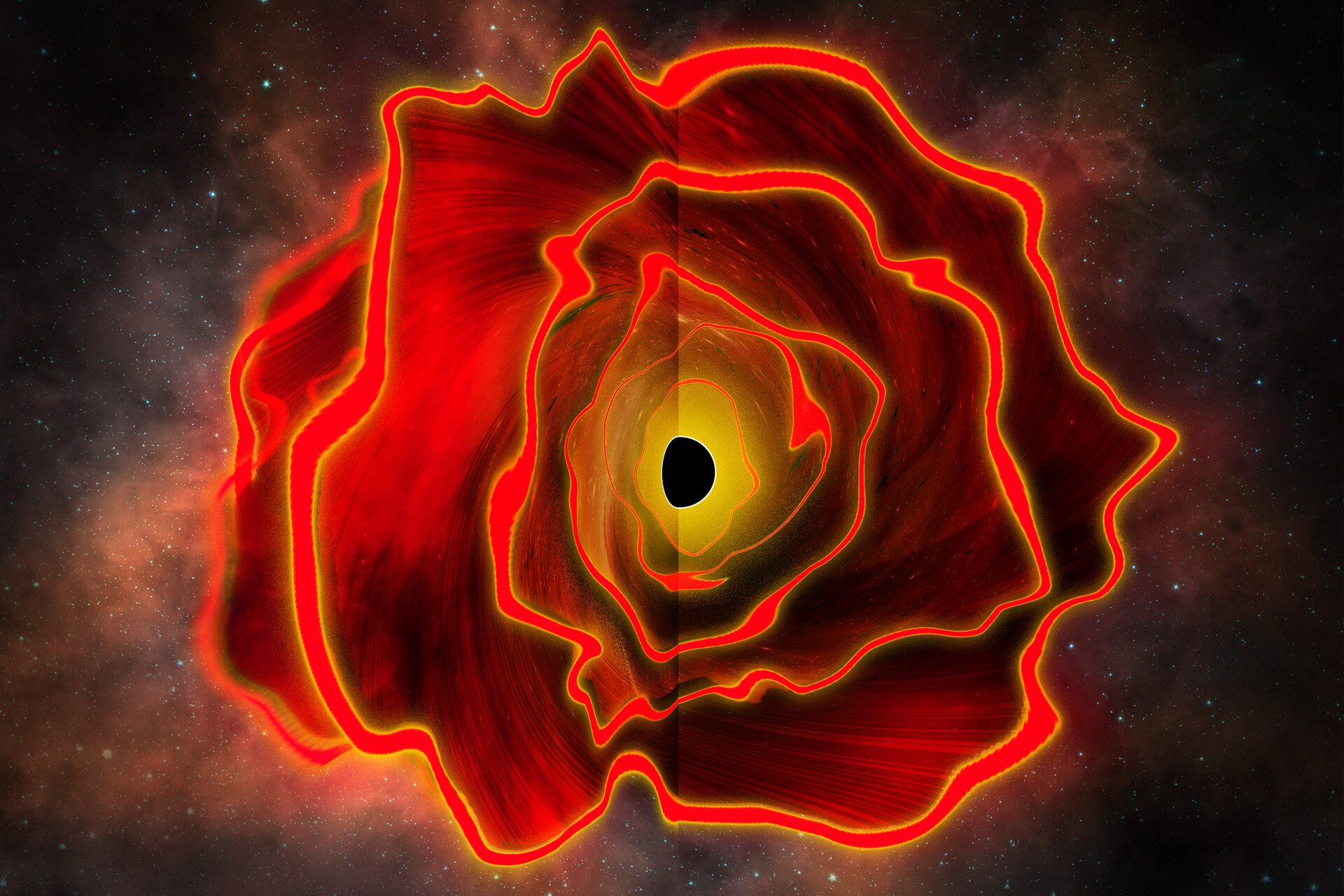
Astronomers at MIT and elsewhere have spotted an extremely bright red spot in the early universe. The object resembles an enormous star, spanning the size of our solar system. But it also is putting out 100 billion times more energy than any known star can physically produce. In fact, such energies are closer to what a black hole might generate. In a paper appearing today in the journal Nature, the team presents their analysis of the new object, which they discovered using NASA's James Webb Space Telescope (JWST). The telescope spotted the bright red dot in the very early universe, just a few hundred million years after the Big Bang. The scientists conclude that the most likely explanation for the strange red dot is that it is a mashup of a black hole and a star ' a combination that has never been observed until now. The object is likely a hugely dense cloud of gas, powered not by standard nuclear fusion, but by a central black hole. 'Our picture of this object is evolving very...
learn more