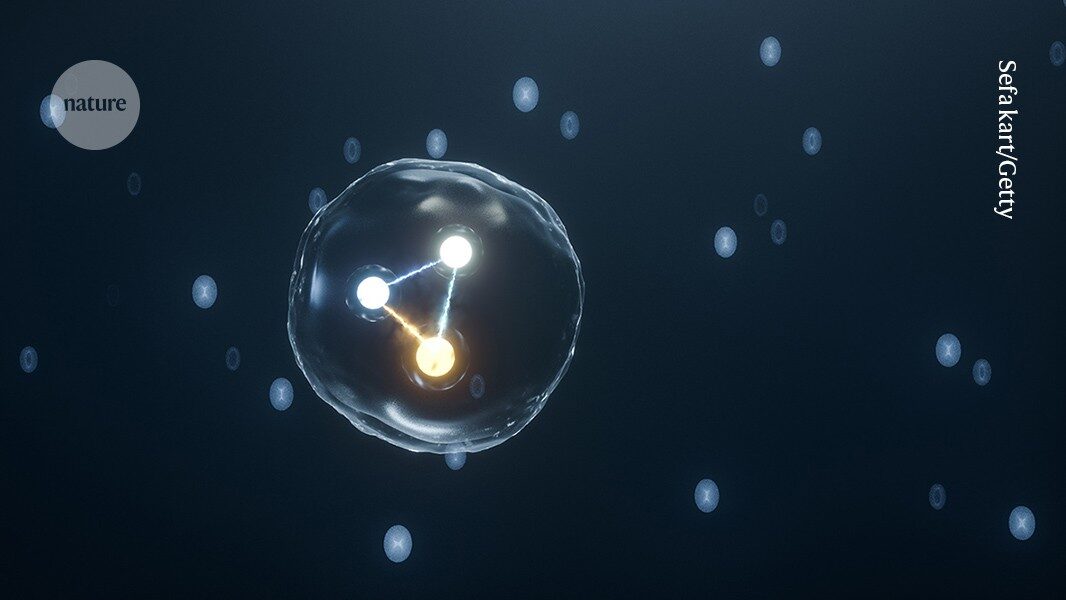
Researchers at the Beijing Spectrometer III (BESIII) Collaboration, an international particle-physics experiment, presented their results at the International Conference on High Energy Physics in Natal, Brazil, last week. They say that a particle known as X(2370) ' which was discovered in 2011 ' is mostly made up of glueballs. These are clusters of gluons, which are the elementary particles that bind quarks to form protons and neutrons and hold them inside the nucleus of an atom. There is no single smoking gun that proves that this particle is made of glueballs, says Bruce Yabsley, a particle physicist at the University of Sydney in Australia, who has reviewed the results from BESIII. But looking at the cumulative evidence that they have built over decades makes the current findings 'quite persuasive', he adds. The discovery of glueballs would provide direct evidence that gluons can interact with themselves, researchers say. This is a key prediction of quantum chromodynamics ' the...
learn more